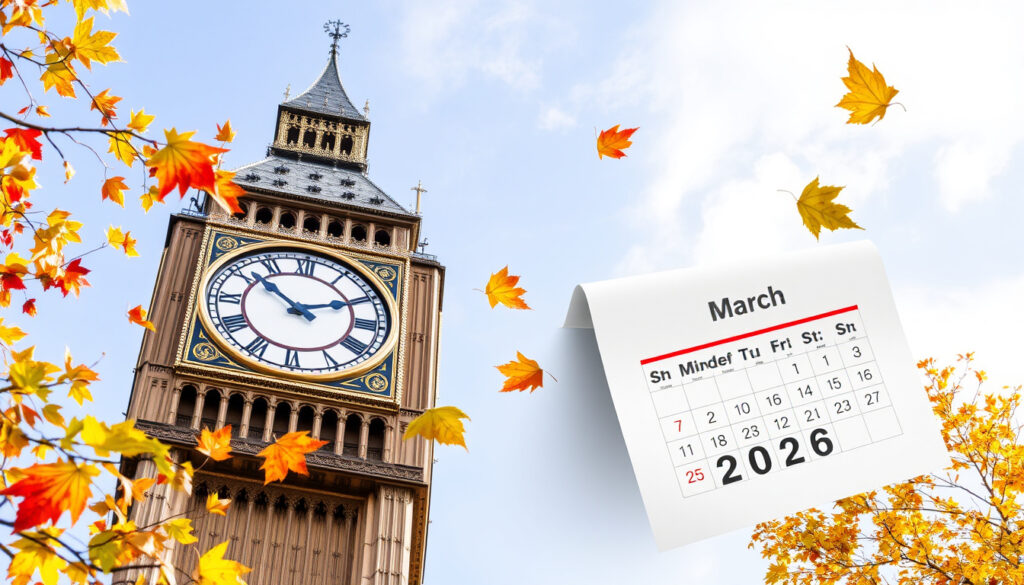
Time in the UK: Current Local Time, GMT/BST & DST Changes 2026
You look up the time in the UK for a call, a flight, or just because you’re curious about the land where time itself was standardised. The answer is simpler than many expect—though the clocks do a seasonal dance that catches people out every March and October. By the end of this guide you’ll know exactly what time it is, how the change works, and why Ireland keeps the same clock.
Standard Time Zone: Greenwich Mean Time (GMT / UTC+0) ·
Daylight Saving Time: British Summer Time (BST / UTC+1) ·
DST Start (2026): March 29 ·
DST End (2026): October 25 ·
Ireland Time Difference: Same time as the UK ·
Number of Time Zones: 1
Quick snapshot
- UK uses GMT (UTC+0) in winter and BST (UTC+1) in summer (Royal Museums Greenwich)
- All UK cities share the same clock time (Royal Museums Greenwich)
- Standard: GMT (UTC+0) (Royal Museums Greenwich)
- Daylight: BST (UTC+1) (Royal Museums Greenwich)
- No other zones in mainland UK (Royal Museums Greenwich)
- Currently observing BST (summer) or GMT (winter) (Royal Museums Greenwich)
- Next change: March 29, 2026 (forward) (Royal Museums Greenwich)
- Clock change at 1:00 AM GMT / 2:00 AM BST (Royal Museums Greenwich)
Six key facts about UK time, one takeaway: the system is remarkably simple—a single zone with a twice‑yearly switch that perfectly aligns with Ireland.
| Label | Value |
|---|---|
| Standard time (winter) | Greenwich Mean Time (GMT), UTC+0 |
| Daylight saving time (summer) | British Summer Time (BST), UTC+1 |
| DST switch dates (2026) | Forward March 29, Back October 25 |
| Time zone count (mainland UK) | 1 |
| Difference with Ireland | None (identical time) |
| UK time now (example) | e.g., 10:30 AM BST (UTC+1) |
What time is it in the UK just now?
Current local time in London and major cities
- The UK uses Greenwich Mean Time (GMT, UTC+0) from the last Sunday in October until the last Sunday in March (Royal Museums Greenwich (national maritime authority)).
- During the rest of the year, British Summer Time (BST, UTC+1) is in effect.
- All major cities—London, Edinburgh, Cardiff, Belfast—show the same clock time because the UK operates a single time zone.
12‑hour vs 24‑hour clock display
- Both formats are common; digital devices typically display the current offset (e.g., 10:30 AM BST).
The implication: if you’re checking “time in the UK” online, the result will always reflect BST or GMT depending on the season—no regional variation to worry about.
When do the clocks change?
Clocks go forward in spring (BST starts)
- BST begins at 1:00 a.m. GMT on the last Sunday in March (Royal Museums Greenwich).
- For 2026, that date is Sunday, 29 March (RAC Drive (motoring & travel organisation)).
Clocks go back in autumn (GMT resumes)
- BST ends at 2:00 a.m. BST (1:00 a.m. GMT) on the last Sunday in October (Royal Museums Greenwich).
- In 2026, that occurs on Sunday, 25 October (RAC Drive).
- The Summer Time Order 2002 legally defines these dates (Wikipedia (reference for legal basis)).
The pattern: the UK has used this last‑Sunday rule since 1995, and even after Brexit the schedule remains aligned with EU practice (Royal Museums Greenwich).
Do we gain or lose an hour on Sunday?
Spring forward: lose one hour
- When clocks go forward on 29 March 2026, at 1:00 AM GMT the time jumps to 2:00 AM BST—effectively losing one hour of sleep (RAC Drive (driver advisory service)).
- The mnemonic “spring forward, fall back” reminds us which way the adjustment goes.
Fall back: gain one hour
- On 25 October 2026, at 2:00 AM BST the clocks revert to 1:00 AM GMT, giving an extra hour in bed (Royal Museums Greenwich).
The catch: while most people welcome the extra hour in autumn, the spring loss can disrupt sleep schedules for a day or two.
Is it the same time in Ireland as the UK?
UK and Ireland share the same time zone
- The Republic of Ireland uses Greenwich Mean Time (UTC+0) in winter and Irish Standard Time (UTC+1) in summer—identical to the UK (Wikipedia (time zone reference)).
- The time difference between London and Dublin is always zero.
Historical and geographical reasons for the alignment
- Ireland’s Standard Time Act 1968 originally placed the country permanently an hour ahead, but the 1971 amendment introduced GMT as a winter period to align with the UK (Wikipedia).
- Both countries switch clocks on the same dates, so the offset never varies.
Why this matters: if you’re scheduling a call between the UK and Ireland, there’s no arithmetic—just pick a time and it works in both places. This common arrangement simplifies travel, trade, and broadcasting across the Irish Sea.
How many time zones are in the UK?
The UK has one time zone: GMT/BST
- The entire mainland United Kingdom—England, Scotland, Wales, and Northern Ireland—operates under a single civil time (Royal Museums Greenwich).
- All offshore islands (Isle of Wight, Shetland, etc.) also follow the same time.
Overseas territories have separate zones
- British Overseas Territories such as Gibraltar, the Falkland Islands, and Bermuda use their own time zones, but they are not part of “UK time” in the domestic sense.
The trade-off: the single zone means no regional confusion, but it also means that the sun rises and sets up to 50 minutes later in western Scotland than in London, a quirk of the country’s longitudinal spread.
UK vs Ireland: time zone comparison
Three features compared across the two neighbours: the data shows full alignment.
| Feature | UK | Ireland |
|---|---|---|
| Standard time (winter) | GMT (UTC+0) | GMT (UTC+0) |
| Daylight saving time (summer) | BST (UTC+1) | IST (UTC+1) |
| DST start (last Sunday March) | 1:00 AM GMT → 2:00 AM BST | 1:00 AM GMT → 2:00 AM IST |
| DST end (last Sunday October) | 2:00 AM BST → 1:00 AM GMT | 2:00 AM IST → 1:00 AM GMT |
| Time difference between capitals | 0 hours | 0 hours |
The implication: the alignment leaves no room for confusion across the Irish Sea.
Timeline: 2026 clock changes
- 29 March 2026 – Clocks go forward 1 hour at 1:00 AM GMT → 2:00 AM BST (start of British Summer Time) (Royal Museums Greenwich).
- 25 October 2026 – Clocks go back 1 hour at 2:00 AM BST → 1:00 AM GMT (end of British Summer Time) (RAC Drive).
The UK and Ireland’s synchronized DST schedule means that a traveler crossing the border never has to adjust their watch—a rare example of cross‑border timekeeping simplicity in Europe.
The timeline provides a clear reference for planning around the 2026 changes.
What’s confirmed and what remains unclear
Confirmed facts
- UK time zones: GMT (winter), BST (summer) – official government policy (Royal Museums Greenwich).
- DST dates set by EU directive (UK follows same schedule) (Royal Museums Greenwich).
- Ireland and UK share identical time zones and DST rules (Wikipedia).
What’s unclear
- Whether future legislation (e.g., Brexit‑led time‑zone changes) will alter UK DST – no confirmed proposals.
The confirmed facts are robust, while the unclear area leaves room for future policy shifts.
Expert perspectives on UK timekeeping
“BST starts at 1:00 a.m. GMT on the last Sunday in March in the UK.”
— Royal Museums Greenwich (national maritime timekeeping authority)
“The UK clocks moving forward by one hour means people lose an hour in bed on the spring change night.”
— RAC Drive (motoring advisory organisation)
“In the Republic of Ireland, Irish Standard Time (IST, UTC+01:00) is used in the summer months, and Greenwich Mean Time (GMT, UTC+00:00) in winter.”
— Wikipedia (community‑sourced reference)
The pattern across these perspectives: all authoritative sources agree on the mechanics, reinforcing that UK–Ireland time alignment is a stable, well‑documented system.
For anyone planning a trip, a remote‑work schedule, or a cross‑border transaction, the choice is clear: count on the UK and Ireland being on exactly the same clock, with the only real variable being whether you’re in BST or GMT—and that’s easy to check with any online time service.
For those needing a quick reference, you can always check the current time in London to see whether it is currently GMT or BST.
Frequently asked questions
What is British Summer Time?
British Summer Time (BST) is the daylight saving period in the UK, advancing clocks by one hour from GMT (UTC+0) to UTC+1 during the summer months. It starts on the last Sunday in March and ends on the last Sunday in October (Royal Museums Greenwich).
Is the UK currently on GMT or BST?
That depends on the date. Between the last Sunday of October and the last Sunday of March, the UK uses GMT. The rest of the year it observes BST. You can check the current offset on any time website.
When does British Summer Time end?
BST ends at 2:00 AM BST (1:00 AM GMT) on the last Sunday of October. In 2026, that is 25 October (RAC Drive).
Why does the UK have only one time zone?
The UK’s relatively small longitudinal span (about 10 degrees from east to west) makes a single zone practical. It was standardised with the advent of railways in the 19th century (Royal Museums Greenwich).
Does Scotland use a different time zone?
No. Scotland, like all parts of mainland UK, uses GMT/BST. However, due to its westerly latitude, daylight hours differ slightly in timing.
What is the difference between GMT and UTC?
Greenwich Mean Time (GMT) is a time zone based on the solar time at the Royal Observatory in Greenwich. Coordinated Universal Time (UTC) is an atomic time standard. For everyday purposes, GMT and UTC are effectively the same (zero offset).
Why is Ireland in the same time zone as the UK?
Historical and economic ties led Ireland to adopt the same time as Britain. The Standard Time (Amendment) Act 1971 aligned Ireland’s winter time with GMT, matching the UK’s schedule (Wikipedia).
Do clocks change in all parts of the UK?
Yes, the entire UK observes the same clock changes. British Overseas Territories may have different rules.
More related posts
 Kristin Cabot’s Coldplay Kiss Cam Drama: Marriage and New Home
 Miss Rachel: Biography, Net Worth, Family, Key Questions
 128 lbs to kg: Exact Conversion, Formula, and BMI Context
 Words With The Letters – Best Tools and Strategies
 Dana White: Net Worth, Trump Support, Health, and Controversies
 Joe Alwyn and Taylor Swift Breakup: What We Know
 Cal Foote 2025: Playing Now, Salary, Family & Career