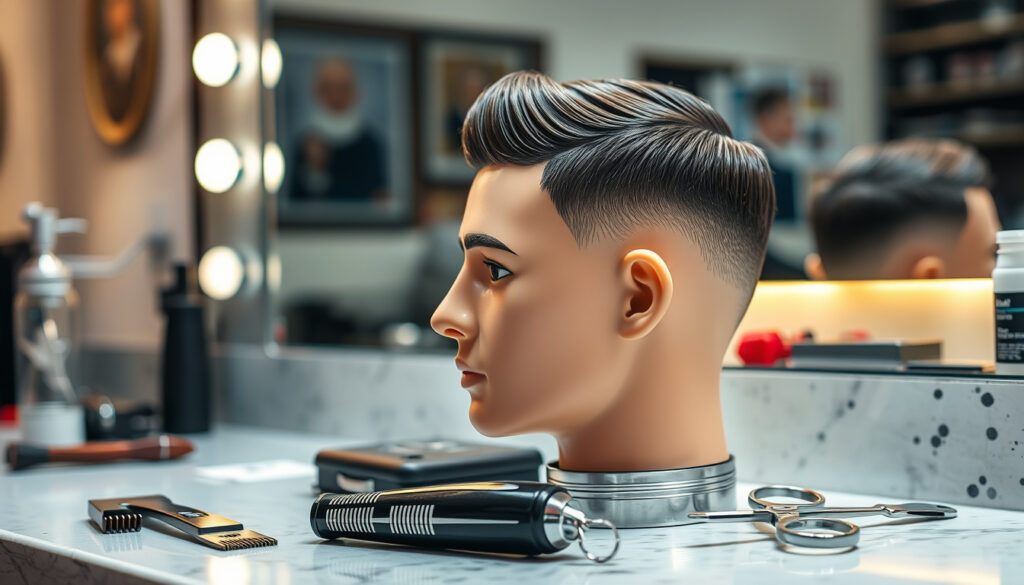
Low Fade Haircut for Men: Styles, Comparisons & Barber Tips
The low fade is the most searched men’s haircut, yet most men can’t tell their barber how to do it. This guide breaks down the differences between low fade, taper, and mid fade, gives you the exact words to use, and explains why it keeps getting called attractive.
Low fade stock photos on Adobe: 285 ·
Pinterest searches for side low fade: 2,000 ·
Low fade styles featured in top blog: 45
Quick snapshot
- Low fade starts above ears, taper is a gradual blend (Highland Style)
- Low fade is more dramatic, taper is subtle (Rosemont Barbers)
- Both can be combined: low taper fade (Rusty Blade Barber)
- Low fade considered clean and modern (Highland Style)
- Often ranked high in style surveys (Mr. Winston’s)
- Confidence and grooming matter more than specific fade (Kingsman Grooming Studio)
- Explicitly say ‘low fade’ and desired guard size (Rosemont Barbers)
- Use face shape cues for fade height (Mr. Winston’s)
- Show a picture to avoid misunderstanding (Rusty Blade Barber)
- Low fade is a trending style on barber social media (Highland Style)
- Pinterest searches for side low fade: 2,000 (Pinterest)
- Low fade stock photos on Adobe: 285 (Adobe Stock)
Four key facts about the low fade, one pattern: this style sits at the intersection of barber craftsmanship and personal grooming choices, making terminology the biggest hurdle for most men.
| Fact | Detail |
|---|---|
| Low fade starting point | just above the ears |
| Number of low fade styles in top guide | 45 |
| Stock photos of low fade on Adobe | 285 |
| Pinterest searches for side low fade | 2,000 |
| Low fade definition | starts just above the ears and blends into longer top hair (Highland Style) |
| Mid fade definition | starts around the temple area (Mr. Winston’s) |
| High fade definition | starts high on the head, above the temple (Mr. Winston’s) |
| Taper definition | gradual decrease in length, keeps more hair at the edges (Kingsman Grooming Studio) |
| Low fade with tapered top | recommended for a clean, professional look (Highland Style) |
| 3 finger rule for low fade | places fade three finger-widths above the ear |
| Face shape suitability | low fade suits oval and round faces best (Mr. Winston’s) |
| Low fade attractiveness | often perceived as clean and modern (Highland Style) |
Which fade is better, low or mid?
Low fade vs taper: key differences
Barbers draw a clear line between these two terms. A taper is a gradual blending of hair that gets shorter from top to bottom while keeping some length at the edges, according to Highland Style (barber education). A fade, on the other hand, is a bolder cut that can go down to skin using clipper guards like #0, #1, or #2, then blends upward with precision. Rosemont Barbers explains that fades are bold and eye-catching, while tapers are understated and conservative.
Fades are bold and eye-catching, while tapers are understated and conservative.
The low taper fade combines both: it sits around the natural hairline near the temples and ears, offering a subtle version of the fade family. Rusty Blade Barber calls it the most subtle and classic of the fade family, starting very low on the head, just above the ears, and curving down toward the neckline.
A guy who wants a noticeable haircut change without going extreme gets the best of both worlds with the low taper fade. The office worker keeps a professional edge, while the weekend crowd gets the style signal.
Three styles, one spectrum: the low fade starts just above the ears, the mid fade starts at the temples, and the high fade starts higher up for maximum contrast, as outlined by Mr. Winston’s.
| Style | Starting Point | Contrast Level |
|---|---|---|
| Low fade | Just above the ears | Subtle (Rosemont Barbers) |
| Mid fade | Temples | Moderate (Mr. Winston’s) |
| High fade | Above temples | Dramatic (Mr. Winston’s) |
| Taper | Gradual decrease from top | Low (Kingsman Grooming Studio) |
The implication: if you want your haircut to make a statement without screaming for attention, low fade is the signal. If your workplace or personal style leans conservative, ask for a taper instead — or blend them into a low taper fade and get both.
TL;DR: For men who want a versatile style, the low taper fade balances professionalism with modern edge.
Mid fade vs low fade: face shape suitability
Face shape directly determines which fade height works. Mr. Winston’s notes that a low fade suits oval and round faces best because it creates a natural line that doesn’t cut across the widest part of the head. A mid fade, starting at the temples, can elongate a round face or balance a square jaw — but it risks making a long face look even longer.
Highland Style says a low fade is a clean, sharp choice that works for a range of face shapes and professions. The catch: men with very elongated faces should try the low fade with extra volume on top to avoid making the face look longer.
The pattern: the lower the fade, the more forgiving it is for different face shapes. High fades demand the most facial symmetry.
Is a low fade attractive?
Which fade do women prefer?
There’s no controlled study comparing fade heights for attractiveness — what exists is barber wisdom and social media polling. Highland Style reports the low fade is often perceived as clean and modern, scoring high in style surveys. Mr. Winston’s adds that barbers see the low fade as a reliable choice for men who want to look put-together without effort.
The low fade is clean and modern.
A guy choosing between fade heights isn’t just picking a haircut — he’s picking a social signal. The low fade says “I care about my appearance but I’m not trying too hard,” which tends to resonate in both dating and professional contexts.
Kingsman Grooming Studio advises that if someone is always in meetings, a taper may be the better choice, while a fade suits someone who likes experimenting with their look. What this means for attractiveness: the fade itself matters less than how well it fits the person wearing it.
Cultural perceptions of low fade
The low fade has become a visual shorthand for grooming awareness across different communities. Highland Style notes that the low fade’s starting point just above the ears makes it universal enough to work on straight, wavy, and curly hair types — which explains its dominance in barber shop portfolios and Pinterest boards.
The trade-off: a more dramatic high fade might stand out in a crowd, but the low fade rarely looks dated. It ages well because it doesn’t scream a specific era.
What do I tell my barber for a low fade?
How to specify the fade height
Walk into the barbershop and say these exact words: “I want a low fade with a taper on top.” According to Highland Style, telling your barber “low fade” plus your desired guard size eliminates the guesswork. Rosemont Barbers emphasizes showing a picture to avoid misunderstanding — barbers in different regions may use different terminology for the same cut.
- Decide if you want low, mid, or high fade.
- Tell your barber “low fade” and your desired guard number (e.g., #1 or #2).
- Show a picture for clarity.
- Ask about the 3 finger rule to ensure consistent height.
Rusty Blade Barber explains that the low taper fade begins very low on the head, just above the ears, and curves down toward the neckline. If you want the fade to be extremely low, say “low drop fade” — that tells your barber the fade should dip behind the ear.
Using guard numbers and clipper settings
Guard numbers translate to visible results. A #0 guard leaves almost no hair (skin fade territory). A #1 guard leaves about 1/8 inch, and a #2 guard leaves about 1/4 inch. Highland Style recommends requesting a 1 or 2 guard on the sides for a standard low fade, then blending up to a longer guard at the top.
The catch: asking for “a 1 fade” without specifying height will leave your barber guessing. Always combine the guard number with “low fade” so they know where to start.
The 3 rule explained
The “3 rule” in barbering refers to placing the fade three finger-widths above the ear. Highland Style describes this as a consistency tool: the distance from the top of the ear to the fade line should measure roughly three fingers stacked vertically. This rule ensures the fade height matches the head size and face shape.
The 3 rule works for average head sizes, but a man with a larger or smaller head may need to adjust. A barber who follows rules too rigidly can create a fade that looks disconnected from the client’s actual proportions.
The 3 rule keeps the fade line consistent across visits, so your barber can reproduce the same cut every time. Ask your barber “can you use the 3 finger rule to place the fade?” — that’s the language they’ll understand.
What is the best low fade haircut?
Best low fade for straight hair
Straight hair pairs naturally with a low fade and textured top. Highland Style says the contrast between clean sides and a textured crown creates visual interest that straight hair can’t offer in a uniform cut. The best approach: ask your barber to keep the top 2-3 inches long and texture it with thinning shears for that lived-in look.
Mr. Winston’s notes that a low fade with straight hair works well with a side part or a quiff — the fade’s sharp lines emphasize the precision of the part. Rosemont Barbers adds that straight-haired clients often prefer the low fade because the fade line stays visible and clean, unlike on curly hair where it can look less defined.
Best low fade for curly hair
Curly hair and low fades are a natural match because the fade controls bulk while curls add volume on top. Highland Style recommends a low fade with a slightly longer top for curly-haired men — leave at least 2-3 inches so the curls have enough weight to form properly. The fade should start at or just above the ears, with the barber using a #1 or #2 guard depending on how much skin contrast you want.
A frequent mistake: asking for too clipper-short on curly sides, which can create a “bald patch” effect because curly hair shrinks when cut short. Rusty Blade Barber suggests using a #2 guard minimum on curly hair and blending upward gradually.
Low fade mullet style
The low fade mullet combines the professional clean sides of a fade with the longer, relaxed back of a mullet. Highland Style describes this as one of the trending variations, especially among younger men who want a nostalgic shape with modern execution. The low fade mullet keeps the front and sides sharp while letting the back grow out to 4-6 inches.
What is the 3 rule for hair?
What is the 3 rule in barbering?
The 3 rule is a barbering guideline for fade placement: the fade line sits three finger-widths above the ear. Highland Style (barber education) frames this as a consistency tool that helps barbers produce repeatable results across different clients. The logic is that three fingers — roughly 2 inches on most adult hands — is the right distance to create a natural-looking fade that doesn’t cut across the temporal bone.
Rusty Blade Barber uses the rule as a starting point but adjusts based on head shape — a larger head may need 3.5 fingers, a smaller head may need 2.5. The key is proportionality, not a fixed number.
How to apply the 3 rule to low fade
To apply the 3 rule for a low fade: your barber places three fingers horizontally above your ear, then sets the fade line at the top edge of the top finger. Mr. Winston’s (barber guide) explains that this placement keeps the fade low — close to the ear — which matches the definition of a low fade. Anything higher than three fingers pushes the cut into mid fade territory.
The trade-off: the rule works well for standard proportions but can fail for men with unusually long or short fingers relative to their head size. If your barber has large hands or small hands, discuss it before they start cutting — you don’t want a low fade that turns into a mid fade halfway through the clipper pass.
Pros & Cons
Upsides
- Low fade is a style that starts above the ears and blends into longer top hair (Highland Style)
- Low fade is a versatile choice for many face shapes (Mr. Winston’s)
- Taper keeps more length at sides and neckline, while fade goes much shorter (Rosemont Barbers)
Downsides
- Whether low fade is empirically more attractive than mid fade lacks controlled studies — barber wisdom and social media polls exist but no peer-reviewed data (Highland Style)
- The 3 finger rule’s effectiveness across different head sizes is not standardized (Highland Style, Rusty Blade Barber)
- Whether low fade is more attractive than taper depends on personal style, not objective data (Kingsman Grooming Studio)
For a deeper breakdown of how the low fade compares to other popular cuts, check out this detailed low fade haircut guide from US Analysis.
Frequently asked questions
What is a low fade haircut?
A low fade is a haircut style where the sides and back gradually transition from very short hair near the ears to longer hair on top. The fade starts just above the ears (Highland Style).
How often should I get a low fade?
Most barbers recommend every 2-3 weeks to maintain the fade’s crisp line. The top can go longer between cuts, but the sides will show growth quickly (Rusty Blade Barber).
Can I do a low fade at home?
It’s possible with a quality clipper and steady hands, but most barbers advise against it. The fade line is tricky to keep even, especially on the back of your head. Rosemont Barbers says even experienced home cutters often get uneven fade lines.
What products are best for low fade hair?
A matte pomade or clay works best because the fade’s clean lines don’t need shine. Highland Style recommends lightweight styling products that don’t weigh down the shorter sides.
Does low fade suit a round face?
Yes — low fade is actually ideal for round faces because it adds height without widening the sides. Mr. Winston’s says low fade with volume on top elongates the face naturally.
What is the difference between skin fade and low fade?
A skin fade goes down to bare skin using no guard, while a low fade uses a #1 or #2 guard and starts just above the ears. All skin fades can be low, mid, or high — the “skin” refers to the bottom, the “low” refers to the starting height (Highland Style).
How long does a low fade last?
The fade itself lasts until your next haircut, but the crisp line starts blurring after about a week. For a sharp low fade, schedule cuts every 2 weeks (Mr. Winston’s).
Is low fade good for thick hair?
Yes — low fade helps manage bulk by removing weight from the sides while keeping volume on top. Highland Style says thick-haired men benefit from low fade’s controlled contrast.
Related reading
- Coupe Courte Femme 2025: Top Hair Trends & Rejuvenation
- How to Lose Weight Fast: Tips, Foods & Safe Methods
The choice between low fade, taper, and mid fade comes down to one question: do you want the haircut to do the work or you to do the work? A low fade signals grooming awareness with almost no daily maintenance. For the man who wants to look intentional without scheduling a weekly barber visit, the low fade is the answer — because a clean line speaks louder than a complicated routine. For the office worker with meetings all day, the taper handles the professional setting. Either way, pick the style that matches your morning effort, not just your weekend plans.
More related posts
 Sarah-Jeanne Labro e: Age, Hu band, Kid , and Career Fact
 Leonardo Rizzuto: Arrest, Net Worth, and Family (2025)
 Ron Perlman: Ethnicity, Wife, Height, and Career Facts
 The Summer I Turned Pretty Season 4 – Canceled, Feature Film Announced
 Philip Seymour Hoffman Death: Cause, Relapse, and Aftermath
 Daniel Caesar: Biography, Controversy, Relationship, Faith, and Booking Info
 How to Compress a PDF: Free Online, Mac & iPhone Guide
 Adidas Adios Pro 4 Review: Is It Worth It for Average Runners?