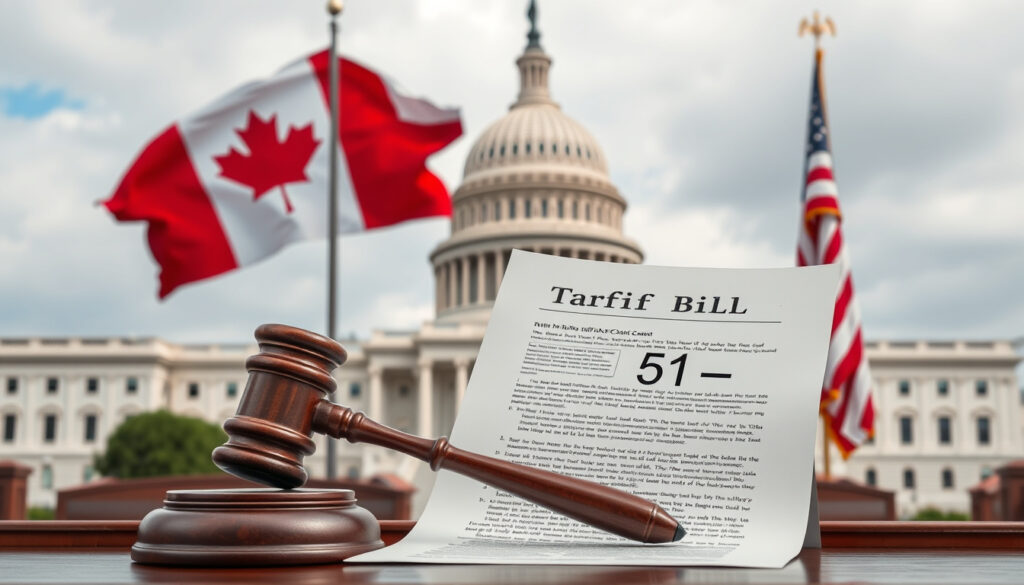
Senate Vote on Tariffs: 51-47 Vote Blocks Canada Tariffs
When the Senate voted in October 2025 to block President Trump’s Canada tariffs, it wasn’t just a policy dispute — it was a rare bipartisan push to reclaim trade authority from the White House. The 51-47 vote marked the first time in years that Congress used its disapproval powers to challenge a national emergency declaration.
Senate vote margin: 51-47 on Oct 30, 2025 · Republican defectors: 4 senators crossed party lines · House vote margin: 219-211 on Feb 12, 2026
Quick snapshot
- Senate voted 51-47 on Oct 30, 2025 to block Canada tariffs (Politico)
- House voted 219-211 on Feb 12, 2026 to revoke Canada tariffs (Economic Policy Institute)
- Four Republican senators supported the Senate resolution (Economic Policy Institute) (Politico)
- Will President Trump veto the resolution?
- Does Congress have the votes to override a potential veto?
- What specific national emergency powers were invoked?
- Emergency declared Feb 1, 2025 (Economic Policy Institute)
- Senate disapproves Oct 30, 2025 (Politico)
- House disapproves Feb 12, 2026 (Economic Policy Institute)
- Resolution heads to President — veto possible (National Association of Home Builders)
- Congress would need 2/3 of both chambers to override (National Association of Home Builders)
- NAHB says Senate can bring similar resolutions every six months (National Association of Home Builders)
Eight key facts capture the legislative battle: the Senate vote on October 30, 2025, ended a national emergency that President Trump had declared just eight months earlier.
| Fact | Value |
|---|---|
| Date of Senate vote | October 30, 2025 |
| Vote outcome | 51-47 in favor of blocking tariffs |
| Emergency declared by | President Donald Trump |
| Tariff target | Imports from Canada |
| Republican defectors (Senate) | 4 senators |
| Date of House vote | February 12, 2026 |
| House vote outcome | 219-211 to revoke tariffs |
| Republican defectors (House) | 6 representatives |
Four Republican senators — Collins, Murkowski, McConnell, and Paul — broke with their party to side with Democrats. That level of intraparty defection on trade is almost unheard-of in recent history (Economic Policy Institute).
Did the Senate vote on tariffs?
When did the Senate vote on Canada tariffs?
The Senate voted on October 30, 2025, to pass a joint resolution (S.J. Res. 77) that would end the national emergency used to justify 25% tariffs on Canadian imports (Politico). A previous attempt in April 2025 failed partly because two senators — Mitch McConnell and Sheldon Whitehouse — were absent (Politico).
What was the final count?
The vote was 51-47. Four Republican senators — Susan Collins, Mitch McConnell, Lisa Murkowski, and Rand Paul — crossed party lines to support the resolution (Economic Policy Institute). The same four later backed similar resolution on global tariffs later that month (Politico).
The implication: the coalition was durable — not a one-off protest.
What does the Senate vote on tariffs mean?
How does a disapproval resolution work?
The resolution, S.J. Res. 37 in April and S.J. Res. 77 in October, operates under the International Emergency Economic Powers Act (Economic Policy Institute). It doesn’t rewrite tariff law; it terminates the state of national emergency that gives the president authority to impose tariffs without congressional approval. The measure needs only a simple majority in both chambers to pass.
What happens after the Senate vote?
The resolution then goes to the House. If the House passes the same resolution, it goes to the President, who can veto it. Congress would then need a two-thirds majority in both chambers to override (Economic Policy Institute). The National Association of Home Builders noted that the Senate can bring a similar tariff resolution to the floor every six months (National Association of Home Builders).
The pattern: Congress is testing its procedural muscle, but the ultimate check remains the veto override.
What was the House vote on tariffs?
How did the House vote on Canada tariffs compare?
The House voted on February 12, 2026, passing a resolution to revoke the Canada tariffs by a margin of 219-211 (Economic Policy Institute). Six Republicans joined all Democrats in supporting the measure — a slightly larger defection rate than in the Senate.
Did the House override Trump veto?
Not yet. The resolution has been sent to the President. The House Speaker had previously made clear the chamber would not vote on measures to roll back tariffs based on a national emergency declaration (National Association of Home Builders). The override path requires a two-thirds vote — 290 in the House and 67 in the Senate — which the current margins make very difficult.
The trade-off: bipartisan disapproval is one thing; a veto-proof supermajority is quite another.
Can the Supreme Court rule on tariff votes?
What is the legal basis for tariff challenges?
Tariff votes are legislative actions — the resolution itself doesn’t create a justiciable controversy that the Supreme Court would typically hear. Legal challenges to tariff authority usually start in lower courts, often based on the Trade Act of 1974 or the IEEPA (Economic Policy Institute). The Supreme Court could weigh in only after lower courts rule on the constitutionality of presidential tariff powers.
Has the Supreme Court heard tariff cases?
Historically, the Supreme Court has steered clear of direct tariff disputes unless they involve constitutional separation-of-powers questions. Recent scholarship suggests that a clear case — like a president defying a congressional tariff resolution — could trigger judicial review, but that hasn’t happened yet.
The catch: for now, the Court is a spectator; the action is entirely legislative.
When will the Senate vote on Canadian tariffs?
Are there future votes scheduled?
The key Senate vote already occurred on October 30, 2025. Future votes depend on whether President Trump vetoes the resolution and whether Congress attempts an override. The NAHB reported that the Senate retains standing to bring a new disapproval resolution every six months (National Association of Home Builders).
What triggered the Senate vote?
The trigger was President Trump’s declaration of a national emergency on February 1, 2025, imposing 25% tariffs on Canadian goods (Economic Policy Institute). The Senate’s bipartisan coalition pushed the disapproval resolution under the expedited procedures of the IEEPA.
What this means: the Senate has shown it can act quickly when presidential tariff authority expands, but the long-term check remains in doubt.
If President Trump vetoes the resolution, Congress will face an immediate test of its bipartisan coalition. The four Republican senators who crossed the aisle would need to hold — and attract two more Republicans in the Senate and six more in the House — to reach the two-thirds override threshold. That’s a steep climb.
Timeline: The Canada tariff disapproval process
- February 1, 2025 – President Trump declares national emergency to impose 25% tariffs on Canadian imports (Economic Policy Institute).
- October 30, 2025 – Senate votes 51-47 to disapprove of the tariffs and end the national emergency (Politico).
- February 12, 2026 – House votes 219-211 to revoke the Canada tariffs (Economic Policy Institute).
- TBD – Resolution sent to President Trump, who may veto; Congress would need 2/3 majority to override.
The timeline shows a pattern: Congress acted swiftly once the emergency was declared, but the final check — the veto override — remains unproven.
Confirmed facts vs. what’s unclear
Confirmed facts
- Senate vote on Oct 30, 2025 passed 51-47 (Politico)
- House vote on Feb 12, 2026 passed 219-211 (Economic Policy Institute)
- Four Republican senators supported the Senate resolution (Economic Policy Institute)
- Six House Republicans supported the House resolution (Economic Policy Institute)
What’s unclear
- Will President Trump veto the resolution?
- Does Congress have the votes to override a potential veto?
- What specific national emergency powers were invoked?
- What legal strategy would a Supreme Court challenge follow?
The contrast between confirmed facts and uncertainties underscores the procedural challenges that remain.
Key voices on the tariff votes
“The Senate has taken a critical step to restore congressional oversight over trade policy. This vote sends a clear signal that tariffs imposed under a national emergency declaration must have broad support.” Senator Tim Kaine (D-VA), quoted in Politico
“Four Republican senators — Collins, Murkowski, McConnell, and Paul — provided the margin of victory, crossing party lines to end the emergency” Politico live coverage
“The House Speaker has made clear the House will not vote on measures to roll back tariffs based on a national emergency declaration.” National Association of Home Builders
The Senate vote on tariffs marked a rare instance of Congress pushing back against presidential trade authority. For American businesses and consumers, the immediate consequence is uncertainty: the tariffs remain in effect until the President signs the resolution or Congress overrides a veto. For the bipartisan coalition that formed around S.J. Res. 77, the next move is clear — hold together and find the extra votes needed for an override, or watch the emergency powers stay in place.
Related reading: Canadian Tariffs on US Goods: Rates, List & 2025 Updates
Frequently asked questions
What is a disapproval resolution for tariffs?
A disapproval resolution is a legislative tool that allows Congress to terminate a national emergency declared by the president under the International Emergency Economic Powers Act. It passes with a simple majority and, if signed, ends the president’s tariff authority tied to that emergency.
How does a national emergency enable tariffs?
When the president declares a national emergency under IEEPA, they gain the authority to regulate imports — including imposing tariffs — without going through normal congressional trade procedures. The declaration is the legal foundation for the tariff.
Can the President veto a tariff disapproval resolution?
Yes. Like any joint resolution, it goes to the President for signature or veto. If vetoed, it returns to Congress, which needs a two-thirds majority in both chambers to override.
What happens if Congress overrides a veto on tariff resolution?
If Congress overrides the veto, the resolution becomes law and the national emergency is terminated, effectively ending the tariff authority. The president cannot then reinstate the same emergency declaration without a new legal basis.
How many votes are needed to override a presidential veto?
Two-thirds of the members present in each chamber. In the Senate, that’s 67 votes if all 100 senators are present. In the House, 290 votes if all 435 representatives are present.
Which Republicans voted against President Trump on tariffs?
In the Senate: Susan Collins (ME), Mitch McConnell (KY), Lisa Murkowski (AK), and Rand Paul (KY). In the House: six Republicans whose names have not been formally listed in public reports.
What goods from Canada were affected by the tariffs?
The 25% tariffs applied broadly to goods imported from Canada. The National Association of Home Builders noted that lumber imports were not covered by the October 2025 resolution, meaning a separate 45% tariff on Canadian lumber remained in place (National Association of Home Builders). For a full breakdown, see our detailed guide on Canadian Tariffs on US Goods.
These answers clarify the steps and possibilities in the tariff vote process.
More related posts
 Ayesha Khan: Age, Controversy, and Rise to Fame
 Spencer Pratt: Bio, Wife, Net Worth, Mayor Run & Politics (2025)
 Ted Danson: Health Scare, Politics, and Sobriety Facts
 Canadian Tariffs on US Goods: Rates, List & 2025 Updates
 Taylor Swift The Life of a Showgirl Songs – Eras Tour Setlist Facts
 What Is Cream of Tartar? Uses, Substitutes & Benefits
 MLP Rainbow Dash: Character Analysis & Fan Theories