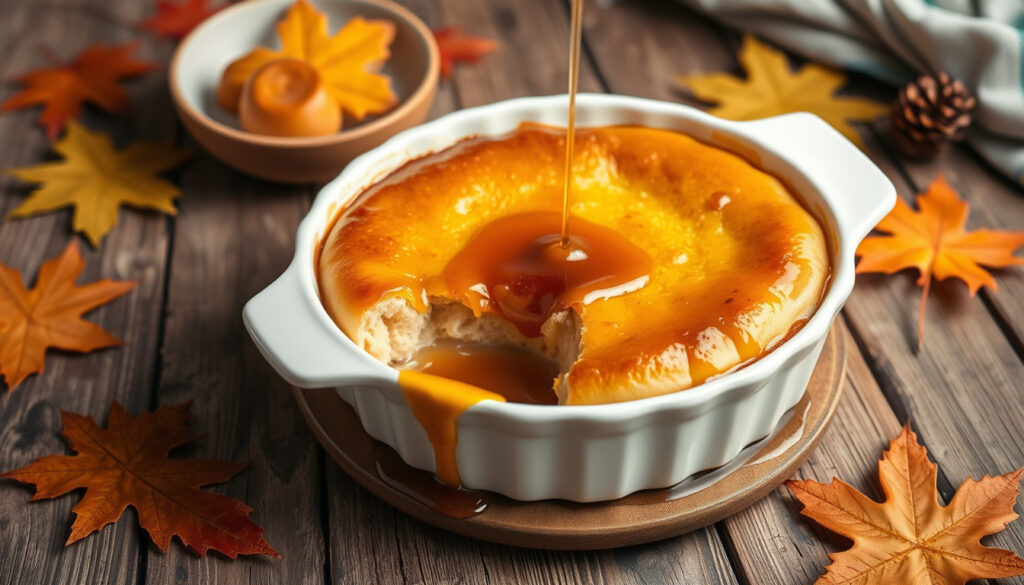
Easy Pouding Chômeur Recipe: Quebec Classic Simplified
Every Quebécois household has a version of this recipe tucked away somewhere—grandma’s yellowed card, a dog-eared magazine clipping, or a shortcut bookmarked on your phone. Pouding philosophe is that unpretentious dessert that somehow manages to feel both rustic and luxurious at the same time. The good news? You don’t need fancy technique or obscure ingredients to pull it off.
Origin: Quebec, 1930s Great Depression · Key Ingredients: Flour, sugar, baking powder, milk, maple syrup · Top Variations: Bob le Chef, Au Pied de Cochon · Classic Prep Time: 15 minutes bake
Quick snapshot
- The French name literally means “pudding of the unemployed” (Food Nouveau)
- Created by female factory workers during the Great Depression in 1929 (Food Nouveau)
- Whether factory workers’ wives or the workers themselves originated the first recipe (Pardon Your French)
- Exact inventor remains undocumented (Pardon Your French)
- 375 ml flour base with maple sauce soak
- 15-minute prep, feeds 6-8
- Step-by-step instructions below for the classic version
- Chef variations for when you want to branch out
The table below distills the essential at-a-glance data from Quebec culinary authorities.
| Attribute | Value |
|---|---|
| Name Meaning | Unemployed pudding |
| Region | Quebec Canada |
| Bake Time | 30-40 minutes |
| Serves | 6-8 |
| Primary Source | Encyclopédie Canadienne |
What is pouding philosophe?
Pouding philosophe is a classic Québécois dessert composed of a vanilla cake soaked in a generous sauce made from maple syrup and cream, according to Ricardo Cuisine (Quebec’s leading culinary publication). The name literally translates to “pudding of the unemployed,” a direct reference to its Depression-era origins when families needed comfort food that wouldn’t break the bank.
Origin in Quebec
The recipe was developed during the Great Depression using ordinary everyday simple ingredients that most people would have in their homes, states The English Kitchen (Quebec culinary blog). Originally, the sauce was made with brown sugar and water rather than the maple syrup that now defines the dish. The recipe was created by female factory workers during the Great Depression in 1929, according to Food Nouveau (Quebec food magazine). A Quebec workers’ union published a cookbook in the 1970s with pouding philosophe recipes to provide easy, low-cost recipe ideas to unemployed workers.
Quebec families kept this recipe alive for decades not because it was fashionable, but because it actually tastes good—and stretching it to feed eight people on a tight budget never hurt either.
Key characteristics
Traditional cake ingredients include 1½ cups sifted flour, 1 tsp baking powder, ¼ cup butter, ⅔ cup sugar, 1 egg, 1 tsp vanilla extract, and ½ cup milk, per Chef Cuisto (Quebec recipe aggregator). Traditionally, families used margarine instead of butter because it was more economical at the time, notes Michel Dumas (Quebec culinary blog). The modern maple version sauce contains 1½ cups pure maple syrup, 1½ cups heavy whipping cream (35% m.f.), and ½ tsp kosher salt.
The implication: what started as a thrifty workaround became a defining taste of Quebec home cooking.
Why is it called pouding philosophe?
The name tells the story: “pouding philosophe” literally means “pudding of the unemployed,” reports Food Nouveau. It’s also known as “Poor Man’s Pudding” or “the pudding of the unemployed” in English circles, according to The English Kitchen.
Historical context
Pouding philosophe was a budget-friendly way to indulge during tough economic times, explains Pardon Your French (Quebec lifestyle blog). The original recipe used simple ingredients: flour, eggs, butter or shortening, and sugar. In the original recipe, the sauce was made with brown sugar and water before maple syrup became the regional standard.
Unemployed origins
Pouding philosophe combines pantry staples like flour, sugar, and butter with a rich, sweet syrup made from maple syrup and cream, according to Pardon Your French. The recipe was reportedly created by female factory workers who needed to feed their families affordably during the economic downturn.
What is Bob le Chef’s pouding philosophe recipe?
Bob le Chef’s recipe is one of the most-shared versions online, offering a classic approach with some modern touches. His recipe has garnered attention for staying true to tradition while making the technique approachable for home cooks.
Ingredients list
- 1½ cups sifted flour
- 1 tsp baking powder
- ¼ cup butter, softened
- ⅔ cup sugar
- 1 egg
- 1 tsp vanilla extract
- ½ cup milk
Step-by-step
The mixing method follows the traditional creaming approach: beat butter and sugar until fluffy, then incorporate egg and vanilla before alternating flour mixture and milk. The batter goes into a greased baking dish while the maple cream sauce heats separately.
What is the Au Pied de Cochon pouding philosophe recipe?
Restaurant versions like the one from Au Pied de Cochon—a celebrated Quebec fine-dining establishment—typically scale up quantities and increase richness. The restaurant approach uses a higher ratio of 35% cream to maple syrup, creating a more indulgent sauce.
Restaurant fame
The Au Pied de Cochon version showcases what happens when a Depression-era budget dessert meets a Michelin-influenced kitchen: the humble origins remain, but the execution gets refined. Home cooks can scale the recipe down by halving or quartering the quantities.
Home adaptation
- Use 250 ml maple syrup and 75 ml 35% cream as a starting point
- Simmer until slightly thickened, about 10-15 minutes
- Pour over cake while both are warm for best absorption
The sauce-to-cake ratio is what separates a good pouding philosophe from a great one. Too little sauce and the cake stays dry; too much and you lose the structure. Most sources agree on roughly 500 ml maple syrup and 150 ml cream for a standard batch.
Easy pouding philosophe recipe
Here’s the classic version distilled from Quebec’s top recipe sites. This one pulls from Ricardo Cuisine (Quebec’s most-visited culinary site) and Michel Dumas (Quebec culinary blog), with measurements standardized across sources.
Ingredients from top SERP
Six Quebec recipe sources converge on these measurements, representing the closest thing to a consensus version:
- 375 ml (1½ cups) sifted flour
- 5 ml (1 tsp) baking powder
- 60 ml (¼ cup) butter, softened
- 160 ml (⅔ cup) sugar
- 1 egg
- 5 ml (1 tsp) vanilla extract
- 125 ml (½ cup) milk
Maple sauce:
- 500 ml (2 cups) pure Quebec maple syrup
- 150 ml (⅔ cup) heavy cream (35% m.f.)
- 2 ml (½ tsp) kosher salt
Simple steps
The Ricardo Cuisine recipe yields 8 portions with 15 minutes preparation and 35 minutes cooking time. Preheat your oven to 180°C (350°F). Cream butter and sugar until light, then beat in egg and vanilla. Add flour and baking powder alternately with milk, mixing just until combined. Pour into a greased 9×13 inch baking dish.
For the sauce, combine maple syrup, cream, and salt in a saucepan. Bring to a simmer over medium heat, cooking 10-15 minutes until slightly thickened without caramelizing, per Michel Dumas. Pour the hot sauce over the raw batter—yes, before baking—and bake 30-40 minutes until the cake part springs back and the sauce bubbles around the edges.
Maple syrup sauce
The sauce is where modern pouding philosophe diverges most dramatically from its Depression-era ancestor. While original versions used brown sugar dissolved in water, today’s Quebec-made versions lean into the province’s maple identity. Érable du Québec (Quebec Maple Syrup Producers Association) recommends 1 cup maple syrup (preferably amber for rich flavor), 1 cup 35% cream, and ¼ cup butter, brought to a boil and simmered for 2 minutes before serving.
“Amber-grade maple syrup delivers the strongest flavor without the rawness sometimes found in lighter varieties.” — Érable du Québec (Quebec Maple Syrup Producers Association)
“The key is to simmer the sauce until it just coats a spoon—pull it too early and it stays runny; let it go too long and you lose the creaminess.” — Michel Dumas (Quebec culinary blog)
Related reading: How Long to Cook a Turkey · Mediterranean Diet Meal Plan
While this Quebec classic soaks its cake in maple syrup and cream, a slow cooker rice pudding offers hands-off comfort with coconut milk and brown rice.
Frequently asked questions
What are the basic ingredients for pouding philosophe?
The classic cake uses 375 ml flour, 60 ml butter, 160 ml sugar, 1 egg, 5 ml baking powder, 5 ml vanilla, and 125 ml milk. The sauce calls for 500 ml maple syrup and 150 ml 35% cream.
How long does pouding philosophe take to bake?
Plan for 30-40 minutes at 180°C (350°F). The Ricardo Cuisine recipe specifies 35 minutes exactly, with 15 minutes of prep work beforehand.
Can pouding philosophe be made without eggs?
The egg provides structure and richness, but an equal-weight substitution like applesauce or mashed banana would work in a pinch. The texture will be slightly denser.
What syrup works best for pouding philosophe sauce?
Pure Quebec maple syrup in amber grade delivers the best balance of strong flavor and sweetness. Lighter grades taste more floral; darker grades can taste too molasses-heavy.
Is pouding philosophe gluten-free?
No—the traditional version uses wheat flour. For a gluten-free version, most recipe bloggers report success substituting a 1:1 gluten-free flour blend.
How to store leftover pouding philosophe?
Pouding philosophe can be stored in the refrigerator for 48 hours and reheated at 110°C for 10-15 minutes, according to Michel Dumas.
What drinks pair with pouding philosophe?
Traditional accompaniments include coffee, black tea, or a glass of cold milk. For an adult pairing, some Quebec restaurants serve it alongside a small pour of maple whisky or local bourbon-style whiskey.
More related posts
 Lisa Gilroy: Biography, Career, TV Shows & Facts
 Ava Gardner: Life, Loves, and Legacy of a Hollywood Icon
 Thierry Henry: Partner, Children, Net Worth & Coaching
 Cal Foote 2025: Playing Now, Salary, Family & Career
 Mac McClung: Why He’s Not in the NBA, Salary, Vertical & More
 Charlotte Tilbury Pillow Talk – Shades and Dupes Guide
 Jodie Comer: Age, Relationships, Net Worth and Career
 The Customer Is Always Right Full Quote Explained