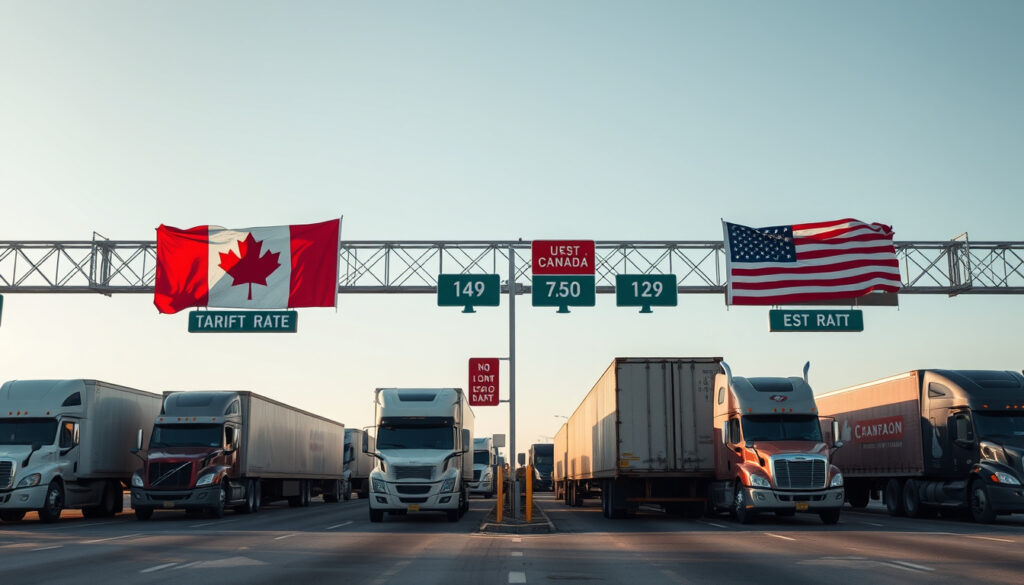
Canadian Tariffs on US Goods: Rates, List & 2025 Updates
Since early 2025, Canada has been layering its own counter-tariffs on US goods—steel, aluminum, cars—in direct response to Washington’s sweeping duties. This tracker cuts through the noise with verified dates, current rates, and what exemptions actually mean for your import costs.
Counter-tariff rate on US steel, aluminum, autos: 25% · Exempt under CUSMA: 0% · US steel/alum rate (Canada): 50% since June 2025
Quick snapshot
- Canada’s 25% surtax targets $29.8 billion in US imports (Government of Canada Finance)
- Enforced under Order SOR/2025-95 as of March 13, 2025 (Canada Gazette)
- Whether additional surtaxes on the announced $125 billion list will activate
- Final resolution timeline for ongoing negotiations
- Sept 1, 2025: Canada removed tariffs on most US goods but kept steel, aluminum, auto surtaxes (KPMG Tax Newsflash)
- Negotiations continue as of early 2026 (KPMG Tax Newsflash)
- Canada may expand tariffs to additional steel derivatives (effective December 26, 2025)
- Steel quota reviews ongoing for non-FTA partners
The following table summarizes the key tariff rates, effective dates, and official sources for Canadian counter-tariffs on US goods.
| Category | Rate / Detail | Effective Date | Source |
|---|---|---|---|
| Canada counter-tariff on US steel, aluminum, autos | 25% surtax | March 13, 2025 | CBSA Customs Notice CN25-11 |
| Targeted US import value | $29.8 billion | March 13, 2025 | Canada Gazette SOR/2025-95 |
| US steel and aluminum tariffs (Canada) | 25% initially, then 50% | March 12, 2025 (25%); June 4, 2025 (50%) | PwC Tax Insights |
| US auto tariffs | 25% | April 3, 2025 | C.H. Robinson Tariff Timeline |
| CUSMA-compliant goods (Canada from US) | 0% (exempt) | Ongoing | PwC Tax Insights |
| Canada tariff removals (most goods) | Removed surtax | September 1, 2025 | KPMG Tax Newsflash |
| US derivative products (407 HTSUS codes) | 50% on steel/aluminum content | August 18, 2025 | C.H. Robinson Tariff Timeline |
Importers should note that these rates apply to the customs value of goods at the time of import clearance, with CUSMA-compliant origin documentation being the primary exemption pathway.
What are some Canadian tariffs on US goods?
Canada’s main countermeasure is a 25% surtax applied to a specific list of US products. The legal basis is the United States Surtax Order (Steel and Aluminum 2025), published as SOR/2025-95 in the Canada Gazette. The order targets $29.8 billion worth of US imports, including steel products, aluminum goods, cast iron, and automobiles.
Steel and aluminum products
The surtax covers a broad range of steel HTS codes and aluminum products originating from the United States. The CBSA’s Customs Notice CN25-11 outlines the specific classifications and origin rules that determine whether the surtax applies. The rate is calculated on the customs value of the goods at the time of import.
Auto imports
Passenger vehicles and auto parts from the US face the same 25% surtax. This applies to complete vehicles and to components where the origin rules trigger the tariff. The C.H. Robinson Tariff Timeline shows auto tariffs took effect April 3, 2025, with auto parts following on May 3, 2025.
Other counter-tariffed items
Beyond the primary categories, the list includes cast iron pipes, certain aluminum cans and containers, and beer in aluminum cans (subject to Section 232 tariffs as of April 4, 2025). The Blakes timeline notes Canada has also imposed 25% tariffs on select global steel-derivative products effective December 26, 2025.
Is the 25% tariff still in effect for Canada?
Yes. The 25% surtax on US steel, aluminum, and automobiles remains active as of September 1, 2025—Canada removed tariffs on many other US products on that date, but kept the surtax on these three categories. The KPMG Tax Newsflash confirms the selective removal, indicating the government preserved the primary leverage points in the trade dispute.
Current status as of 2025
The surtax has not been repealed. Canada’s position has been consistent: the tariffs remain in place until the US removes its own duties on Canadian goods. Negotiations are ongoing, but no resolution had been announced by late 2025. PwC’s analysis shows the 25% rate is applied uniformly to qualifying goods that meet the origin criteria.
Exemptions under CUSMA
Goods that qualify as originating under the Canada-United States-Mexico Agreement (CUSMA) are exempt from the surtax. The PwC guidance notes CUSMA exemptions for US-origin goods were available from March 7, 2025, and have remained in place. Over 85% of Canada-US trade continues to flow tariff-free due to CUSMA, according to Wikipedia’s trade war overview.
Recent changes
The most significant recent change was the September 1, 2025 removal of surtaxes on a broad range of US products—including many consumer goods, machinery, and agricultural products—that were not part of the core steel, aluminum, and auto categories. This selective removal reduced friction for most trade while maintaining pressure on the targeted sectors.
Canadian tariffs on US steel, aluminum and auto imports
The surtax applies specifically to goods that originate in the United States. This means the determination hinges on rules of origin—where the product was manufactured or substantially transformed. The Department of Finance Canada published the official product list concurrent with the tariff’s effective date.
Steel tariffs details
The steel surtax covers a range of Harmonized Tariff Schedule (HTS) codes for various steel forms—flat-rolled, bars, tubes, pipes, and certain derivatives. The Blakes timeline notes Canada also set tariff rate quotas for steel imports from non-FTA partners at 20% of 2024 levels, effective June 27, 2025. Non-CUSMA FTA partners face quotas at 75% of 2024 levels.
Aluminum tariffs details
Aluminum products from the US—including ingots, sheets, plates, foil, tubes, and pipes—are subject to the 25% surtax. The CBSA enforces these rates through Customs Notice CN25-11. Notably, Canada’s own aluminum imports from other countries have also seen policy shifts, including the December 26, 2025 imposition of 25% tariffs on select global steel-derivative products.
Auto sector impacts
The auto sector faces compounding pressures. The US imposed its own 25% tariff on Canadian autos effective April 3, 2025 under Section 232, while Canada responded with the 25% surtax on US vehicles. The C.H. Robinson Tariff Timeline documents the cascade: autos on April 3, auto parts on May 3, and subsequent derivative expansions.
How much is import duty from the US to Canada?
Import duty rates from the US to Canada depend heavily on the product type and its origin. For goods originating from the US that fall under the counter-tariff list, the rate is 25%. For goods that meet CUSMA origin requirements, the rate is 0%. The PwC analysis provides a breakdown of how these rates apply to different product categories.
MFN vs applied tariffs
Canada’s applied tariff rates under trade agreements often differ from the Most Favored Nation (MFN) base rates published in the tariff schedule. For US goods, CUSMA preferential rates typically reduce duties substantially or to zero for originating goods. The 25% surtax applies on top of the MFN rate where it is triggered—making effective rates significantly higher for non-originating goods.
Personal shipments under $20 CAD
Canada’s de minimis threshold allows personal shipments valued under $20 CAD (from the US) to enter without duties and taxes, though this has been subject to policy discussions in the broader trade environment. Commercial imports above this threshold are subject to the full tariff assessment.
Commercial imports
For commercial shipments from the US, the surtax is calculated on the transaction value of the goods. The CBSA applies this at the time of import clearance. Importers should verify the HTS code classification and origin documentation carefully, as misclassification or incorrect origin claims can trigger retroactive assessments and penalties. The CBSA notice outlines the specific documentation requirements.
Does Canada have tariffs on U.S. goods?
Yes. Canada has active counter-tariffs on US goods, implemented through a series of surtax orders beginning in March 2025. Prime Minister Justin Trudeau called the US tariffs “entirely unjustified” on February 10, 2025, and Canada has maintained its retaliatory measures as negotiations continue. The Wikipedia timeline of the trade war captures the official statements and escalation sequence.
General policy
Canada’s counter-tariff policy targets specific US industries that were the source of Washington’s Section 232 and IEEPA actions. The approach is calibrated—maintaining tariffs on the key sectors while removing duties on less strategically significant goods to reduce overall friction. The Blakes timeline documents how this selectivity evolved through 2025.
Retaliatory measures
The retaliatory package originally included tariffs on approximately $30 billion of US goods. Canada also announced a potential $125 billion surtax by April 2, 2025 if US tariffs persisted, according to the Canada Gazette. That larger package has not been activated as of late 2025, but remains available as a escalation option.
Pre- and post-2025 rates
Before 2025, most Canada-US trade flowed under CUSMA at 0% or very low MFN rates. The previous US steel/aluminum tariffs (2018) had Canada exemptions until May 31, 2018, and again from May 20, 2019. The current round applies to all countries without exemptions, as documented by PwC. The shift has been significant for the targeted sectors.
The complete list below documents all product categories subject to Canada’s counter-tariffs, including affected HTS codes and legal basis.
| Product Category | HTS Codes Affected | Rate | Legal Basis |
|---|---|---|---|
| Steel (various forms) | Multiple HTS chapters 72-73 | 25% surtax | SOR/2025-95 |
| Aluminum (ingots, sheets, plates) | Chapter 76 (selected codes) | 25% surtax | SOR/2025-95 |
| Automobiles (passenger vehicles) | Chapter 87 (HS 8703) | 25% surtax | SOR/2025-95 |
| Auto parts | Chapter 87 (selected codes) | 25% surtax | SOR/2025-95 |
| Cast iron pipes and tubes | HS 7303-7306 | 25% surtax | SOR/2025-95 |
| Aluminum cans and containers | Chapter 76 (selected) | 25% surtax | SOR/2025-95 |
| Steel derivatives (global) | December 26, 2025 expansion | 25% | Blakes timeline |
The implication: Businesses importing these categories must verify both HTS code classification and origin documentation to determine whether the 25% surtax applies or whether CUSMA exemptions eliminate the charge entirely.
Timeline of Canada’s counter-tariffs on US goods
US Executive Orders signed by President Trump for 25% steel and aluminum tariffs citing national security
US 25% tariffs on steel and aluminum take effect for all countries including Canada
Canada imposes 25% surtax on $29.8 billion US goods (SOR/2025-95)
US 25% tariffs on Canadian autos take effect under Section 232
US doubles steel and aluminum tariffs to 50% for Canada via proclamation
Canada sets steel tariff rate quotas: 20% of 2024 levels for non-FTA partners
US adds 407 HTSUS codes as steel/aluminum derivatives subject to 50% tariffs
Canada removes retaliatory tariffs on most US goods, keeps surtax on steel, aluminum, autos
Canada imposes 25% tariffs on select global steel-derivative products
What’s confirmed vs. what’s still uncertain
Confirmed
- 25% surtax on US steel, aluminum, autos per official government orders (CBSA, Finance Canada)
- CUSMA exemptions verified and operational
- September 1, 2025 selective removal of most retaliatory tariffs confirmed by KPMG
- SOR/2025-95 published in Canada Gazette
Uncertain
- Whether the standby $125 billion surtax list will be activated
- Final resolution timeline for ongoing negotiations
- Post-December 2025 expansion scope for steel derivatives
- Future rate adjustments if trade talks progress
What experts and officials are saying
The tariffs were entirely unjustified.
— Justin Trudeau, Canadian Prime Minister (Wikipedia Timeline)
Canada and the European Union vowed to retaliate firmly against the US tariffs.
— France 24 report, cited via Wikipedia Timeline)
The tariff rate on a $100,000 commercial shipment of US steel to Canada is $25,000 in surtax if the goods don’t qualify for CUSMA. For automotive components moving across the border frequently, even a single misclassified shipment can mean tens of thousands in unexpected costs. Importers must treat origin documentation as a critical compliance priority, not an afterthought.
For importers and businesses relying on cross-border supply chains, the stakes are concrete. The 25% surtax doesn’t just add a line item—it can reshape the economics of sourcing decisions that were made years before these tariffs existed.
Related reading: Canada US Travel Visa Integrity Fee · 100000 USD to CAD
Frequently asked questions
Which countries have tariffs on US goods?
Multiple countries have imposed counter-tariffs on US goods since 2025. Canada, the European Union, China, and others have retaliated against US tariffs. Canada specifically has targeted $29.8 billion in US goods with 25% tariffs on steel, aluminum, and automobiles.
Do I have to pay tariff on items shipped from the USA to Canada?
Commercial imports from the US may face a 25% surtax if the goods are on Canada’s targeted list and do not meet CUSMA origin requirements. Personal shipments under $20 CAD are generally exempt. Commercial shipments above that threshold are subject to the standard duty assessment plus any applicable surtax.
Canada tariffs on U.S. cars?
Yes. Canada imposes a 25% surtax on passenger vehicles (HS 8703) and auto parts from the United States. This is in addition to the US 25% tariff on Canadian autos that took effect April 3, 2025, creating a two-way escalation in the auto sector.
What countries use tariffs the most?
Tariff rates vary significantly by country and product category. Developed economies like Canada and the US typically maintain lower applied rates through trade agreements, but both have raised tariffs substantially on specific sectors since 2025 as part of the ongoing trade conflict.
Which country sends 80% of its exports to the United States?
Canada is highly dependent on US trade, with roughly $700 billion in bilateral trade annually. The US is Canada’s largest export market by far, making Canadian businesses particularly sensitive to tariff changes that affect cross-border flows.
What is the impact of tariffs on Canadian businesses?
Canadian businesses importing US steel, aluminum, or auto products face 25% surtax costs on non-CUSMA goods. This increases input costs for manufacturers, raises prices for consumers, and creates supply chain uncertainty. Businesses with CUSMA-compliant goods can avoid these costs by ensuring proper origin documentation.
Is the 25% tariff still in effect for Canada?
Yes. The 25% Canadian surtax on US steel, aluminum, and automobiles remains in effect as of September 2025. Canada removed tariffs on many other US goods on September 1, 2025, but maintained the surtax on these three core categories as leverage in ongoing negotiations.
More related posts
 Rafael Devers Trade: Why Red Sox Sent Him to Giants
 Sonya Sharp: Biography, Political Career, Age, and More
 Lisa Blackpink: Biography, Rumors, and Verified Facts
 Tiffany Stratton: Relationship, Career & WWE Highlights
 Your Friends and Neighbors: Season 1 Guide & Season 2 News
 Phil Kessel Free Agent: Status, Timeline & Latest News
 Dress Graduation: What to Wear Under Your Gown (2025)
 Ash Wednesday 2026: Date, Meaning and Fasting Rules