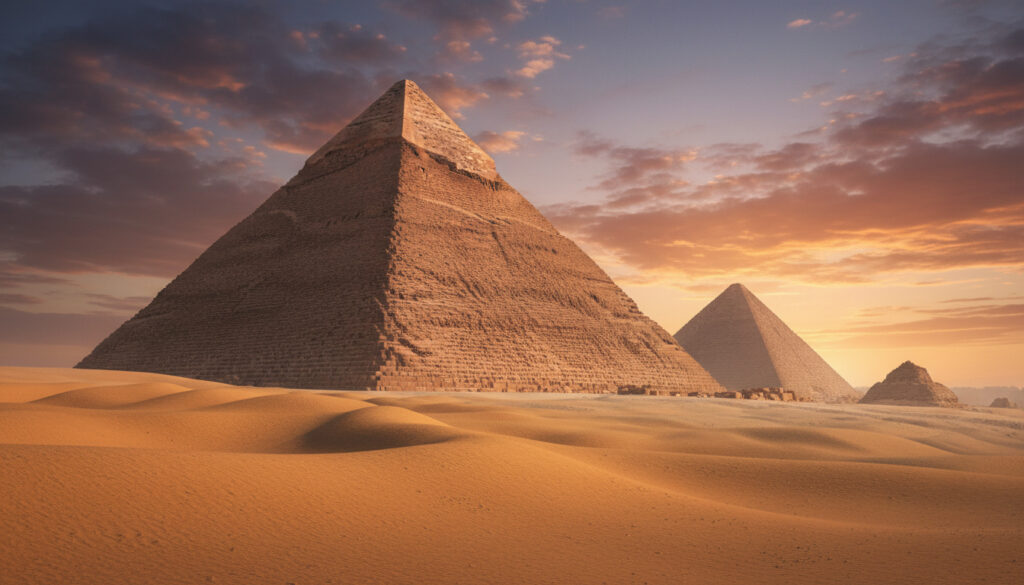
The Great Pyramid of Giza – Facts, Construction and Secrets
Who Built the Great Pyramid of Giza?
Standing on the Giza plateau for over four millennia, the Great Pyramid remains the most enduring symbol of ancient Egyptian engineering. Constructed for Pharaoh Khufu during the Fourth Dynasty around 2580–2560 BC, this monumental tomb held the record as the world’s tallest manmade structure for more than 3,800 years. Its sheer scale and precision continue to define our understanding of Old Kingdom capabilities.
Archaeological evidence indicates that Hemiunu, Khufu’s vizier, served as the principal architect overseeing a workforce of skilled laborers rather than slaves. The complex included bakeries, breweries, and organized housing, suggesting a sophisticated logistical operation designed to sustain construction over two decades. Smarthistory’s detailed analysis confirms the pyramid served as the final resting place for Khufu’s ka, or spirit.
- The pyramid served as the tomb for Pharaoh Khufu’s ka, or spirit.
- Hemiunu, Khufu’s vizier, is identified as the project architect.
- Construction required placing approximately 2.3 million stone blocks.
- The base platform was leveled to within 2.1 centimeters over bedrock.
- It remained the world’s tallest structure until the Eiffel Tower (1889).
- Worker villages housed skilled artisans with access to bakeries and medical care.
- UNESCO designated the Giza pyramid complex a World Heritage Site in 1979.
| Attribute | Measurement |
|---|---|
| Original Height | 146.6 m (481 ft) |
| Current Height | ~138.5–138.8 m |
| Base Length | 230.3 m per side |
| Total Blocks | ~2.3 million |
| Average Block Weight | 2.5 tons |
| Heavy Granite Beams | 50–70 tons |
| Construction Duration | 20–23 years |
| Alignment Error (North) | <0.05° |
How Was the Great Pyramid of Giza Built?
Construction began with leveling the Giza plateau bedrock to within 2.1 centimeters using fine white Tura limestone slabs. This precision provided the foundation for a structure that would weigh approximately 6 million tons upon completion. Archaeological findings indicate the project required coordinated efforts across the Nile Valley.
Quarrying and Material Transport
Workers quarried limestone blocks across the Nile using copper chisels, saws, and dolerite hammers. Arsenical copper tools—an early bronze alloy—enhanced cutting efficiency despite rapid wear rates of one inch lost per one to four inches cut. A 6.5-kilometer canal facilitated transport by boat, while sledges moved stones overland to the site.
Ramping Systems and Lifting
Archaeologists propose multiple ramp configurations working in concert. External spiral ramps made of rubble wrapped around the pyramid’s sides, though their limited capacity likely slowed upper-level construction. Internal ramp theories suggest a spiral corridor built within the structure itself, featuring a modest 7% grade suitable for hauling. Research on central ramp models indicates systems with staircases and post holes for ropes may have handled steep 20% slopes near the apex.
Engineers achieved the 20–23 year construction window by placing roughly five blocks per minute during peak phases, utilizing a multi-technique adaptive approach that changed as the pyramid rose.
Binding and Precision
Gypsum mortar, heated from raw gypsum with wood fires and mixed with rubble, filled gaps between blocks. This mortar embedded charcoal traces visible today. Contrary to alternative theories positing poured concrete, distinct quarry marks and tool striations on blocks confirm they were carved and placed individually. Engineering analyses affirm the feasibility of this multi-method approach within the established timeline.
What Are the Dimensions and Size of the Great Pyramid?
The pyramid’s geometry demonstrates near-perfect execution. Each side of the base measures 230.3 meters, forming a square with sides equal to within 2.1 centimeters. Documentary evidence confirms the original height of 146.6 meters has diminished to approximately 138.8 meters following the loss of the polished Tura limestone casing stones.
Mass and Distribution
Approximately 2.3 million blocks constitute the structure. The core comprises rough-hewn local limestone, while the now-missing outer casing consisted of polished Tura limestone. Within the interior chambers, granite beams weigh between 50 and 70 tons each.
Geometric Precision
The base aligns to true north with an error of less than 0.05 degrees, likely achieved through stellar observations or water-leveling techniques. This accuracy remained unmatched in ancient construction.
What Is Inside the Great Pyramid of Giza?
The interior presents a complex network of passages and chambers designed for royal burial and spiritual transition. Three primary chambers exist at different levels: the subterranean chamber carved into bedrock, the Queen’s Chamber, and the King’s Chamber.
The King’s Chamber and Relieving Compartments
The King’s Chamber sits near the pyramid’s center, constructed from red granite and containing an empty granite sarcophagus. Above it, five relieving chambers distribute the massive weight of the masonry above, preventing collapse of the burial vault.
The Grand Gallery
A corbelled ascending corridor known as the Grand Gallery extends 47 meters long and rises 8.6 meters high. Its design likely facilitated the movement of granite beams via ramps and levers during construction.
The ScanPyramids project detected a “big void” approximately 30 meters long above the Grand Gallery in 2017, followed by a “North Face Corridor” measuring 9 meters in 2023. Researchers continue non-invasive surveys to determine whether these spaces served structural or ceremonial purposes.
Unexplored Regions
Despite these discoveries, significant portions of the interior remain unexcavated or blocked by ancient sealings. No intact royal mummy has survived within the pyramid due to looting in antiquity.
How Has the Great Pyramid Changed Over 4,500 Years?
- : Construction begins under Pharaoh Khufu and architect Hemiunu.
- : Completion after 20–23 years of continuous work.
- : Caliph Al-Ma’mun breaches the structure, creating the forced entrance used by tourists today.
- : Systematic archaeological excavations begin, including detailed mapping of interior passages.
- : ScanPyramids announces detection of a large void using cosmic-ray muon tomography.
- : Discovery of the North Face Corridor confirms additional unexplored spaces.
What Do We Know for Certain About the Great Pyramid?
| Established Facts | Remaining Uncertainties |
|---|---|
| Built as tomb for Pharaoh Khufu (Fourth Dynasty) | Exact configuration of construction ramps |
| Constructed between 2580–2560 BC | Purpose of recently discovered voids |
| Contains approximately 2.3 million blocks | Full contents of unexcavated chambers |
| Hemiunu served as architect | Original appearance of capstone |
| Aligned to true north within 0.05 degrees | Exact population of worker settlements |
| Built by paid skilled laborers, not slaves | Complete burial goods originally interred |
Why Does the Great Pyramid Remain Culturally Significant?
As the sole surviving monument of the Seven Wonders of the Ancient World, the Great Pyramid anchors Egypt’s UNESCO World Heritage status and generates substantial tourism revenue. Its construction represents the apogee of Old Kingdom engineering, demonstrating centralized authority capable of mobilizing resources across the Nile Valley.
The structure also serves as a permanent refutation of pseudo-historical narratives. Archaeological evidence—including worker villages, tool marks, and quarry sites—confirms human construction using copper implements and ramps rather than extraterrestrial intervention. Contemporary engineering studies continue to draw lessons from its multi-technique adaptive construction methods. For those interested in ancient dietary practices of the region, exploring the Mediterranean Diet Meal Plan – 7-Day Guide for Beginners offers insight into modern nutritional science derived from traditional foods.
What Do Primary Sources and Experts Say?
The Egyptians said that the reign of Cheops [Khufu] was afflicted with every kind of evil, and that he compelled all the Egyptians to work for him.
Herodotus, Histories, Book II (5th Century BC)
Modern scholars interpret Herodotus’s account skeptically. Mark Lehner, director of Ancient Egypt Research Associates, has demonstrated through excavation of worker villages that the labor force consisted of skilled artisans working in organized rotations rather than slaves. For more information on the Great Pyramid of Giza, you can explore the ${economia espacial italiana}. economia espacial italiana
The discovery of the bakeries, the fish bones, the evidence of good nutrition and medical care for the workers—all this points to a sophisticated support system for a massive public works project.
Mark Lehner, Ancient Egypt Research Associates
What Should Visitors Know Before Exploring the Pyramid?
Visitors enter the Great Pyramid through the forced entrance created by Caliph Al-Ma’mun in 820 AD, ascending narrow passages to reach the King’s Chamber. The interior climate remains constant but humid, and the steep inclines require physical stamina. Photography is restricted inside to preserve the ancient atmosphere. While unrelated to ancient history, visitors checking health guidelines for their pets might find this guide useful: Are Strawberries OK for Dogs – Safety, Benefits and Tips.
Frequently Asked Questions
How many stones are in the Great Pyramid of Giza?
Approximately 2.3 million blocks constitute the structure, with an average weight of 2.5 tons each.
Has the Great Pyramid of Giza been fully explored?
Significant portions remain unexcavated, including recently detected voids above the Grand Gallery.
Why was the Great Pyramid originally built?
It served as the eternal tomb for Pharaoh Khufu’s ka, or spirit.
What mysteries remain unsolved?
Researchers debate the purpose of internal voids and the exact ramp configurations used during construction.
Can tourists enter the Great Pyramid?
Yes, though tickets are limited and interior passages require climbing steep, narrow corridors.
How accurately is the pyramid aligned?
The base aligns to true north within 0.05 degrees, a remarkable feat of ancient surveying.
Were slaves used to build the pyramid?
No, archaeological evidence indicates skilled, paid laborers lived in dedicated worker villages with access to medical care and quality food.
More related posts
 France President: Emmanuel Macron, Wife & Key Facts
 Julian Brown Missing Inventor: Plastoline Mystery and Return
 Walmart Rewards™ Mastercard® – Rewards Fees and 2025 Status
 Lisa Gilroy: Biography, Career, TV Shows & Facts
 Milly Alcock: Age, Career, and the Controversy with Matt Smith
 Earth Day Quiz: Find Your Animal & Answers
 Ellen Barkin: Animal Kingdom Exit, Marriage, Depp Trial
 Mediterranean Diet Meal Plan – 7-Day Guide for Beginners