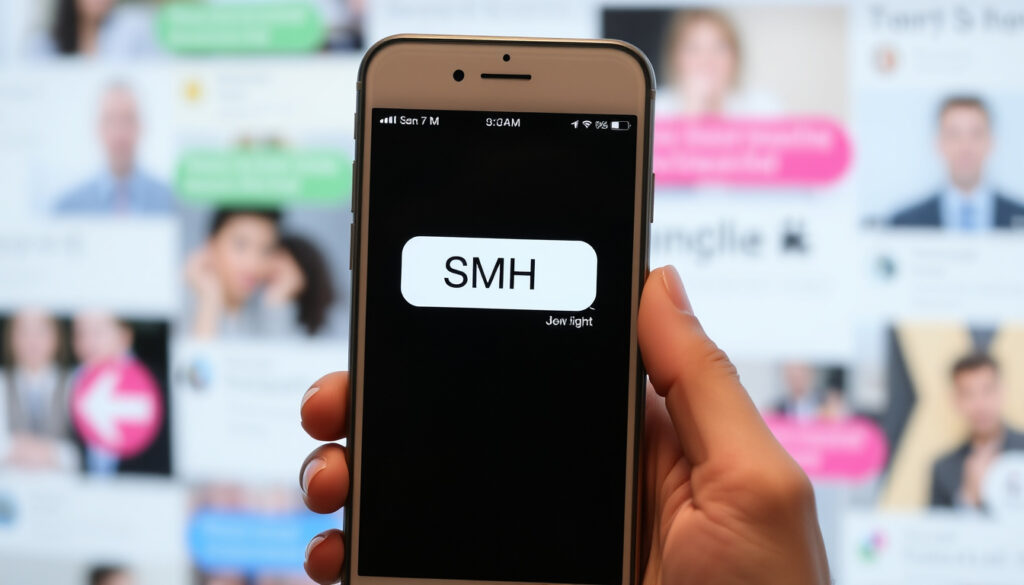
What Does SMH Mean? Definition, Usage, and Examples
Few three-letter abbreviations pack as much expression as SMH. Odds are you’ve seen it in a text, on Twitter, or in a TikTok comment, and you’ve probably guessed its meaning: SMH stands for “shaking my head” — a digital sigh that conveys disbelief, frustration, or just plain exasperation.
Standard Meaning: shaking my head ·
First Known Use: early 2000s ·
Tone: informal, often exasperated ·
Emoji Equivalent: 🤦 (facepalm) ·
Alternative Definition (Urban Dictionary): so much hate (unverified)
Quick snapshot
- Acronym for “shaking my head” (Merriam-Webster, dictionary publisher)
- Common reaction to something frustrating or ridiculous (Gabb, family safety resource) (Merriam-Webster, dictionary publisher)
- Originated in early 2000s internet chat (YourTango, lifestyle publication) (Merriam-Webster, dictionary publisher)
- In text messages, social media posts, and comments (Gabb, family safety resource)
- Often alone or with an emoji like 🤦 (Fenced.ai, online safety blog)
- Also used ironically (e.g., “smh my head”) (Merriam-Webster, dictionary publisher)
- SMDH – “shaking my damn head” (Merriam-Webster, dictionary publisher)
- “SMH my head” – redundant humorous form (Merriam-Webster, dictionary publisher)
- 🤦♀️ emoji pair (Fenced.ai, online safety blog)
- Safe in casual conversations (Gabb, family safety resource)
- Avoid in formal/professional communication (YourTango, lifestyle publication)
- May be considered dismissive if overused (Bark, parental monitoring service)
Five key facts about SMH, one pattern: the acronym has one dominant meaning with a handful of nuanced alternatives.
| Fact | Detail |
|---|---|
| Full Form | shaking my head (Merriam-Webster, dictionary publisher) |
| Year of First Notable Use | 2001 (YourTango, lifestyle publication) |
| Part of Speech | Acronym / interjection (Merriam-Webster, dictionary publisher) |
| Tone | Informal, often sarcastic or exasperated (Gabb, family safety resource) |
| Platform of Origin | Internet relay chat and early SMS (YourTango, lifestyle publication) |
| Intensified Variant | SMDH – “shaking my damn head” (Merriam-Webster, dictionary publisher) |
| Alternative Meaning (Uncommon) | “so much hate” or “scratching my head” (Merriam-Webster, dictionary publisher; Gabb, family safety resource) |
| Emoji Pair | 🤦 or 🤦♀️ (Fenced.ai, online safety blog) |
What does smh mean in text?
SMH stands for “shaking my head.” According to Merriam-Webster, the authoritative dictionary publisher, the abbreviation “often is used to impart a sense of bemused incredulity, or of frustration or disapproval.” It’s a stand-in for the physical gesture of shaking your head in disbelief or disappointment. Gabb, a family safety resource, notes that SMH is “commonly used in online communication such as social media posts and text messages.”
The acronym emerged in early internet chat rooms around the early 2000s, though exact origin dates are hard to pin down. YourTango, a lifestyle publication, traces its first widespread use to around 2001. Like many internet abbreviations, SMH was born from the need to type emotions quickly.
SMH is a virtual head-shake that signals “I can’t believe this” without typing a whole sentence. For casual texters, it saves time; for readers, it carries the same weight as a sigh.
The pattern: SMH replaces a physical gesture, making it a quick emotional shorthand in digital conversations.
What does SMH 🤦♀️ mean?
The facepalm emoji (🤦) often accompanies SMH to reinforce the feeling of exasperation. Fenced.ai, an online safety blog, notes that the gesture mimics shaking one’s head side to side, while the emoji adds a visual “I can’t even” layer. Together, they create a stronger emotional punch — similar to writing “SMH facepalm.”
This combination is especially common on platforms like TikTok and Snapchat, where reactions are short and visual. Bark, a parental monitoring service, reports that kids and teens often use SMH (sometimes with the emoji) to express displeasure. The pairing essentially says: “This is so absurd I have to cover my face.”
While SMH + 🤦 is widely understood among younger users, a parent or older colleague may miss the nuance. Always gauge your audience before relying on the combo.
The implication: this combo amplifies the reaction but narrows the audience; know your reader.
Is smh disrespectful?
SMH is informal and can be perceived as dismissive in serious contexts. YourTango, a lifestyle publication, describes SMH as expressing “general disapproval, exasperation, and frustration.” When used in a work email or with someone you don’t know well, that tone can come across as rude or uninterested.
However, among friends and in casual digital spaces, SMH is generally safe. Gabb, a family safety resource, advises that “slang meanings vary by location, groups, and context.” The key is relationship and setting. Using SMH in a professional Slack channel aimed at a boss? Risky. Dropping it in a group chat with buddies? Fine.
- Casual conversation: acceptable and common
- Academic or workplace writing: avoid — can seem dismissive
- First-time interaction: not recommended until you gauge the other person’s style
When a girl says "smh"?
Gender doesn’t change the literal meaning of SMH. Whether sent by a girl or a guy, the acronym still stands for “shaking my head.” However, interpretation can depend on the relationship and tone. According to Lovecouplez, a relationship advice site, SMH is often used as “a casual reaction used to express disbelief, disappointment, or mild frustration.”
When a girl says SMH, she may be showing playful exasperation (if the conversation was lighthearted) or genuine annoyance (if the topic was serious). The same is true when a guy says it. TSMeaning, an acronym dictionary, notes that SMH can express “disbelief, frustration, or humor.” The emotional context matters far more than the sender’s gender.
What does smh mean from a guy?
Same answer — the meaning holds. However, some users on Fenced.ai, an online safety blog, report that guys occasionally use SMH to downplay a serious response or to avoid sounding overly emotional. The abbreviation allows a quick vent without an elaborate explanation.
Over-analyzing SMH by gender is a dead end. The abbreviation is gender-neutral; its emotional weight comes from the conversation’s tone, not the sender’s identity.
What this means: focus on context and tone, not on who typed the acronym.
What does SMH mean dirty?
Some online dictionaries, particularly Urban Dictionary, have proposed sexual or vulgar expansions for SMH. Merriam-Webster, the dictionary publisher, notes that SMH is “sometimes glossed as ‘scratching my head'” but does not list any explicit variant. The dominant and widely accepted meaning remains “shaking my head.”
Gabb, a family safety resource, acknowledges that some sources list rarer alternatives such as “so much hate” or “so much hype,” but these are “not the dominant sense.” Similarly, Fenced.ai, an online safety blog, says that rare interpretations exist but are “uncommon.”
Yes, a quick Urban Dictionary search will surface explicit variants. But in real-world texting, social media, and messaging apps, SMH overwhelmingly means “shaking my head.” Parents may want to know about the fringe definitions, but the average teen uses it without any dirty connotation.
The pattern: fringe definitions exist but rarely surface in everyday use; stick with the dominant meaning.
Confirmed facts and what’s unclear
Confirmed facts
- SMH stands for “shaking my head” (Merriam-Webster, dictionary publisher)
- First appeared in early 2000s internet chat rooms (YourTango, lifestyle publication)
- Common in texting and online communication (Gabb, family safety resource)
- Intensified variant SMDH stands for “shaking my damn head” (Merriam-Webster, dictionary publisher)
- Merriam-Webster defines SMH as conveying “bemused incredulity, frustration, or disapproval” (Merriam-Webster, dictionary publisher)
What’s unclear
- The exact year SMH became widely used — estimates range from 2001 to 2005 (YourTango, lifestyle publication)
- Whether alternative expansions like “so much hate” were ever mainstream or just fringe entries (Gabb, family safety resource)
- Whether some early users intended “scratching my head” rather than “shaking my head” (Merriam-Webster, dictionary publisher)
- Capitalization preference: SMH vs. smh — no standardized rule (YourTango, lifestyle publication)
Quotes and expert perspectives
Three voices help define SMH’s role in modern digital language:
“SMH … often is used to impart a sense of bemused incredulity, or of frustration or disapproval.”
— Merriam-Webster, dictionary publisher
SMH is “used to express general disapproval, exasperation, and frustration.”
“Kids often use SMH to express displeasure.”
The pattern: across all sources, SMH is a reaction marker — it conveys emotion, not information. Its primary job is to save the user from typing “I’m shaking my head at how ridiculous this is.”
Summary: what to do with SMH
SMH is the internet’s shorthand for a head-shake, and it works because everyone instinctively understands the gesture. For casual texters, it’s a time-saver that adds personality. For parents and professionals, the implication is clear: SMH is harmless in informal chats, but the alternative definitions and dismissive tone mean it should stay out of work emails and formal messages. The consequence for parents: knowing SMH and its variants helps you read your teen’s digital language without overreacting. For regular users: use SMH freely among friends, but pause before sending it in a context where tone matters.
Frequently asked questions
What does SMH stand for?
SMH stands for “shaking my head,” a common internet acronym used to express disbelief, frustration, or disapproval in text messages and social media (Merriam-Webster, dictionary publisher).
Is SMH used in formal writing?
No, SMH is informal and should be avoided in professional or academic writing, where it may be perceived as dismissive or unprofessional (YourTango, lifestyle publication).
How should I respond to someone who says SMH?
It depends on context. If the person is expressing frustration, acknowledge their feeling. If they’re using it playfully, you can respond with a lighthearted comment or an emoji. There’s no standard response.
What are other texting acronyms similar to SMH?
Common examples include LOL (laughing out loud), BRB (be right back), FWIW (for what it’s worth), and IDK (I don’t know). SMH belongs to the same family of initial-letter abbreviations (Merriam-Webster, dictionary publisher).
Does SMH have different meanings in different countries?
While the dominant meaning is consistent across English-speaking countries, some regions may have additional slang uses. Gabb, a family safety resource, notes that slang meanings can vary by location and group.
Can SMH be used sarcastically?
Yes. Users often employ SMH ironically, sometimes adding a redundant “my head” for humorous effect (e.g., “smh my head”). The tone is usually clear from context (Merriam-Webster, dictionary publisher).
What is the difference between SMH and LOL?
SMH conveys disappointment, disbelief, or exasperation — it’s a negative reaction. LOL expresses amusement or laughter. Both are gesture-based acronyms that replace physical reactions (Merriam-Webster, dictionary publisher).
More related posts
 Does Eleven Die in Stranger Things? Season 5 Fate Explained
 Lisa Rinna: What Happened? Housewives Exit, Family Health
 When Is GST 2025 in Singapore and Canada? Dates & Amounts
 Richard Burton: Death, Love Life, and Legacy of a Welsh Actor
 Megan Skiendiel: Biography, Ethnicity, Personal Life & FAQs
 Kristen Bell: Biography, Family, Career, and Common Questions Answered
 Shira Haas: Facts, Career, Height & Disability Rumors Explained
 God Save the King Lyrics: Full Text, History, and Controversies