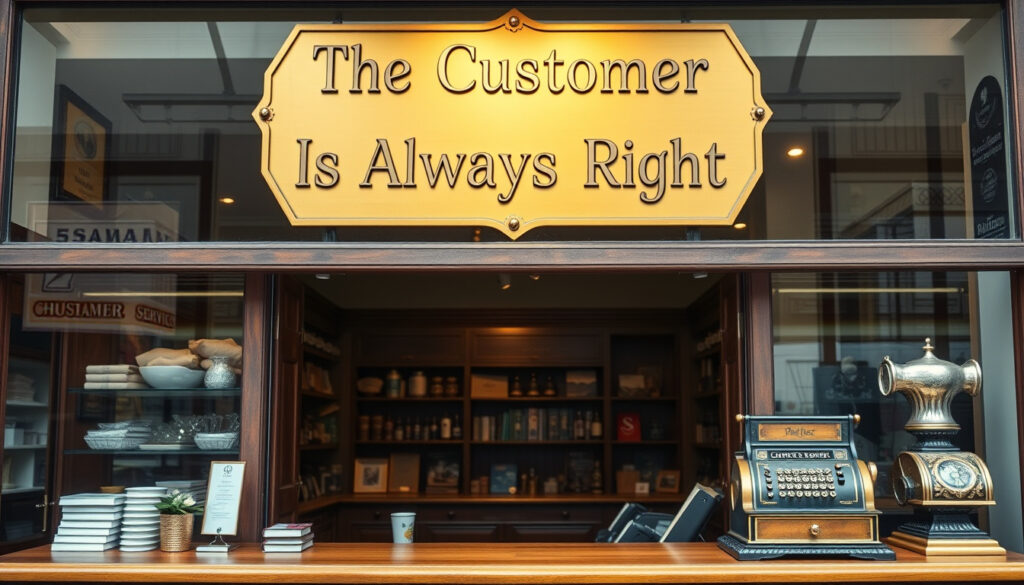
The Customer Is Always Right Full Quote Explained
If you’ve ever worked retail, you’ve probably heard the phrase “the customer is always right” wielded like a shield against every complaint. But there’s a longer version floating around online that adds four simple words — and it’s making people question everything they thought they knew about customer service.
Attributed Originator: Harry Gordon Selfridge · First Known Use: 1909 · Common Extension: in matters of taste · Top Source Tier: Wikipedia
Quick snapshot
- No primary source confirms Selfridge ever used the phrase (Mental Floss)
- Exact wording variations before 1905 remain unverified (Mental Floss)
- Whether Selfridge independently created or adopted the phrase from Field is uncertain (Mental Floss)
- September 1905: Boston Globe printed earliest known mention (Wikipedia)
- 1908: César Ritz’s French variant recorded (Wikipedia)
- 1909: Selfridges opened with customer-first policies (Wikipedia)
- Modern retailers increasingly acknowledge exceptions to the rule (Quote Investigator)
- “In matters of taste” myth continues spreading on social media (Wikipedia)
This table summarizes the core facts that most sources confirm about the phrase and its origin.
| Fact | Value |
|---|---|
| Popular Short Quote | The customer is always right |
| Extended Version | The customer is always right, in matters of taste |
| Primary Source | Harry Gordon Selfridge (1909) |
| Verification Sites | Wikipedia, Snopes |
| Selfridge Fate | Lost fortune later in life |
What is the full phrase for the customer is always right?
You’ve likely encountered two versions of this slogan online. The short form — “The customer is always right” — appears everywhere from employee training manuals to motivational posters. But a longer version has gained traction in recent years, particularly on social media platforms like TikTok, which claims the phrase was originally abbreviated from something more nuanced.
Common misconceptions
The viral version suggests the full phrase was “The customer is always right, in matters of taste” — implying that the original slogan had built-in limitations. This extension reportedly gives retail workers permission to push back when customers make factual errors or behave unreasonably. However, Snopes found no evidence for this extended quote attributed to Selfridge or any other early retailer, according to Wikipedia’s compilation of fact-checking sources.
Attributed full version
Another variant sometimes attributed to Selfridge is “Rule number one: the customer is always right. Rule number two: If the customer is wrong, please refer to rule number one.” Grammarist notes this circular version circulates widely online, though no primary source documentation supports Selfridge as its originator either.
Who originally said the customer is always right?
Pinpointing the exact originator proves surprisingly difficult. Multiple retail pioneers have been credited over the years, and the phrase likely evolved through oral tradition before appearing in print. Quote Investigator tentatively ascribes the adage to Marshall Field based on 1905 Boston newspaper reports, though the attribution remains debated among etymology researchers.
Early retail pioneers
The phrase was popularized by several influential retailers, including Harry Gordon Selfridge, John Wanamaker, and Marshall Field. Each championed customer-first policies during an era when “caveat emptor” (let the buyer beware) dominated commercial exchanges. According to Wikipedia, the slogan emerged as a direct counter to widespread misrepresentation in goods exchange — creating trust where none existed.
Source verification
Mental Floss notes that no evidence exists for the proverb appearing in print before the September 1905 Boston Globe story mentioning Marshall Field. Quote Investigator’s research, drawing from the Yale Book of Quotations, confirms this earliest documented usage, though oral circulation before that date remains possible but unverifiable.
Did Harry Selfridge say the customer is always right?
Harry Gordon Selfridge, founder of Selfridges in London, is frequently credited with originating the phrase. His store opened in 1909 with customer-friendly policies that were considered radical at the time — and British press ridiculed the “customer is always right” approach as unheard of in London’s retail environment.
Selfridge biography
Mental Floss reports that Selfridge actually worked for Marshall Field as a stock boy and department manager before founding his own London empire. This professional connection raises the possibility that Selfridge adopted Field’s customer-first philosophy directly from his American mentor, then introduced it to British consumers. A 2016 Chicago Tribune story credits Selfridge with popularizing both the phrase and tactics like “shopping days until Christmas.”
Quote attribution evidence
Mental Floss confirms that Selfridge is occasionally credited with “the customer is always right, in matters of taste,” but no readily accessible source confirms this specific wording. Selfridge may have adopted or created the phrase independently or from Field — the evidence simply doesn’t exist to settle the question definitively. The association between Selfridge and the slogan remains strong culturally but weak historically.
What is the customer is always right in matters of taste meaning?
If taken literally, the “in matters of taste” extension would mean customers should be deferred to only on subjective matters — color preferences, aesthetic choices, style opinions. On factual disputes or pricing arguments, staff would have legitimate grounds to push back. This interpretation has obvious appeal to workers dealing with unreasonable demands.
Literal interpretation
The original phrase carried no such limitations. According to Quote Investigator, Alfred Pittman in 1919 stated Field’s exact version was “Assume that the customer is right until it is plain beyond all question that he is not.” Field’s policy made the customer the sole judge of issues between buyer and house — a sweeping declaration, not a qualified one. When customers were assumed right, Quote Investigator notes, they usually did the right thing, making the policy practical rather than merely philosophical.
Retail application
In practice, many retailers have quietly abandoned the absolute interpretation. A 1936 newspaper editorial, cited by Mental Floss, stated: “The customer is not quite always right. There is such a thing, very seldom, as the unreasonable customer… we abide by our old slogan that the customer is always right, and at the same time we relieve ourselves of a possibly impossible position by adding the two words ‘almost always.'” This admission that the slogan needed qualification appeared just decades after its popularization.
The “in matters of taste” extension gives the slogan a loophole it never originally had — and that loophole has made the myth more popular than the reality ever was.
What is the truth about the customer is always right?
The truth is more complicated than either fans or critics of the slogan suggest. The phrase was never an absolute principle even in its earliest retail applications — it was a business philosophy designed to build trust in an era of widespread deception. Over time, it became both weapon and shield, invoked selectively depending on which party benefited.
Modern critiques
Contemporary business analysts frequently argue the slogan enables customer abuse. Quote Investigator documents how the policy was described by Howard Vincent O’Brien as breaking down mistrust barriers in goods exchange — but also notes that when taken to extremes, it empowers bad behavior. The phrase counters “caveat emptor” when misrepresentation was common, but modern consumers have recourse to reviews, return policies, and regulations that didn’t exist in 1905.
Exceptions in practice
Barry Pain in 1917 used both “le patron n’a jamais tort” and “the customer is always in the right” in his novel Confessions of Alphonse, showing the phrase had already entered cultural shorthand within two decades of its emergence. César Ritz’s French equivalent “Le client n’a jamais tort” (the customer is never wrong) from 1908 carried a similar absolutist tone — yet hotel staff obviously had latitude to refuse unreasonable requests.
The social media myth of “in matters of taste” emerged in the 21st century, gaining traction on TikTok and Reddit without historical basis. This modern addition says more about current worker frustrations than about retail philosophy from Selfridge’s era.
Timeline: From 1905 to Today
Seven documented milestones trace the phrase’s journey from newspaper shorthand to viral slogan.
This timeline tracks how the phrase evolved through multiple retailers and cultural shifts over more than a century.
| Date | Event |
|---|---|
| November 1905 | Earliest printed mention appears in Boston Globe article about Marshall Field |
| November 1905 | Corbett’s Herald mentions unnamed multimillionaire merchant’s policy |
| 1908 | César Ritz’s “Le client n’a jamais tort” first recorded |
| 1909 | Selfridges opens in London; policy ridiculed by British press |
| 1917 | Barry Pain uses variants in Confessions of Alphonse |
| 1919 | Alfred Pittman details Field’s exact quote version |
| 1936 | Store editorial modifies slogan to “almost always right” |
| 21st century | Social media myth of “in matters of taste” emerges |
The pattern reveals a slogan that evolved through use rather than being coined by any single figure. Field gets earliest documented credit, Selfridge gets cultural credit for popularization, and the “in matters of taste” addition represents a 21st-century reinterpretation with no historical basis.
Upsides
- Built customer trust when deception was common
- Shifted power balance from sellers to buyers
- Created framework for returns and satisfaction guarantees
- Established retail differentiation in competitive markets
Downsides
- Enables unreasonable customer behavior
- Puts staff well-being at risk for optics
- Creates legal liability when policy conflicts with safety
- Mythical “in matters of taste” version overshadows actual history
What Experts and Records Say
Assume that the customer is right until it is plain beyond all question that he is not.
— Marshall Field (per Alfred Pittman, 1919, Quote Investigator etymology analysis)
Le client n’a jamais tort. The customer is never wrong.
— César Ritz (hotel founder, Quote Investigator quote compilation)
The customer is not quite always right. There is such a thing, very seldom, as the unreasonable customer… we abide by our old slogan that the customer is always right, and at the same time we relieve ourselves of a possibly impossible position by adding the two words ‘almost always.’
— Unnamed store (1936 editorial, Mental Floss retail history article)
Bottom line
The “customer is always right, in matters of taste” version circulating online is a modern invention without historical support. The original phrase was coined by Marshall Field, popularized by Harry Selfridge, and never carried the qualifier that social media now insists was always there. For retail workers dealing with difficult customers today, the inconvenient truth is that the slogan was never as flexible as they might hope — and the myth, ironically, gives them more latitude than the original ever did.
Related reading: Back to the Future quotes and secrets · song meaning explained
Frequently asked questions
Is the customer always right in practice?
No. Even in 1936, retailers were modifying the slogan to “almost always right.” Modern businesses routinely refuse service when customers become abusive, dangerous, or make unreasonable demands — contradicting any absolute interpretation.
Why is the full quote often shortened?
The short form “The customer is always right” became a convenient shorthand for customer-first policies. The “in matters of taste” extension appears to be a 21st-century addition designed to limit the slogan rather than expand it.
What happened to Harry Selfridge’s wealth?
Selfridge lost his fortune later in life amid business decline. His 1909 retail revolution ultimately couldn’t prevent personal financial troubles, adding an ironic twist to his customer-first legacy.
Are there better customer service slogans?
Modern businesses increasingly favor phrases like “The customer is our priority” or “Satisfaction guaranteed” — which commit to specific outcomes rather than making absolute declarations that invite abuse.
What do the 3 R’s of customer loyalty mean?
The 3 R’s typically stand for Reward, Recognition, and Retention — modern frameworks for building customer relationships that move beyond simplistic slogans to measurable engagement strategies.
How does the quote apply to taste only?
It doesn’t — the “in matters of taste” limitation is a modern myth. The original phrase made no exceptions, though practical application always required judgment calls.
Is the quote from Reddit discussions accurate?
Reddit threads frequently cite the “in matters of taste” version as established fact, but Wikipedia, Snopes, and Quote Investigator research confirm no primary source documents this extension. Social media users appear to have invented the qualifier to justify pushing back on unreasonable customers.
More related posts
 British Columbia School Shooting – Tumbler Ridge 2026 Timeline Victims
 Elizabeth Banks Biography: Career, Family, and Net Worth
 Miss Rachel: Biography, Net Worth, Family, Key Questions
 Marwah Rizqy Biography: Expulsion and Career
 Milly Alcock: Age, Career, and the Controversy with Matt Smith
 Jey Uso: Family, Career, and Why He Lost His WWE Title
 God Save the King Lyrics: Full Text, History, and Controversies
 David Harbour: Biography, Relationship Split, Mental Health & More