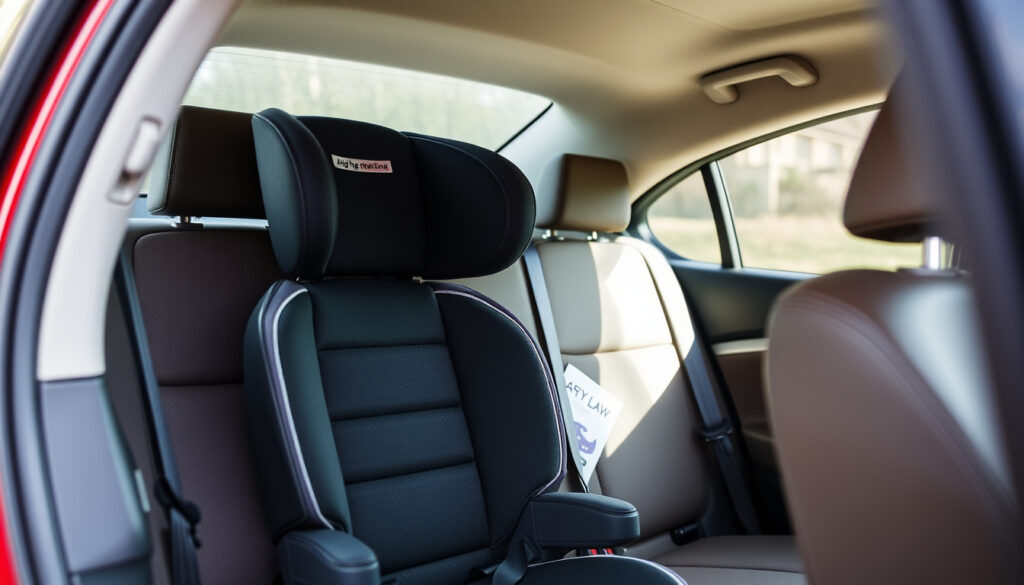
High Back Booster Seat Age: Ireland Law & Safety Guide
Few car seat decisions leave Irish parents as unsure as the move from a forward-facing harness to a booster. The rules seem clear on paper — but between the RSA guidance and the reality of a restless child, the practical path can feel fuzzy.
Legal requirement for child restraint in Ireland: Until 150 cm or 12 years old ·
Minimum age for forward-facing seat: 15 months ·
Recommended minimum age for high-back booster: 4 years (15 kg) ·
Typical weight range for high-back booster: 15–36 kg
Quick snapshot
- Start with a high-back booster (Tusla guidance)
- Ensure child meets minimum weight (15 kg) (Chicco)
- Check head support – ears below booster top (Tusla)
- Continue high-back for head and side protection (Halfords Ireland)
- If very tall (over 125 cm), consider backless option (Tusla)
- Monitor fit of lap and shoulder belt (NHTSA)
- Transition to backless when child reaches 150 cm or ears are above high-back (Tusla)
- Backless allowed legally from 125 cm / 7 years (Tusla)
- Always follow manufacturer’s height limit (Chicco)
- High-back offers head and side protection until 150 cm (Tusla)
- Many 7-year-olds still benefit from high-back (Halfords Ireland)
- ISOFIX reduces installation errors (Tusla)
The table below outlines the key legal and safety facts.
| Fact | Value |
|---|---|
| Legal minimum age for booster seat | 4 years |
| Minimum weight for high-back booster | 15 kg (33 lb) |
| Maximum height for booster use in Ireland | 150 cm (approx 12 years) |
| ISOFIX compatibility | Available on many high-back models; reduces installation errors |
| Backless booster legal from | 125 cm or 7 years |
What age do you switch to a high back booster seat?
Legal requirements in Ireland
The Tusla – Child Safety in Cars guidance states that children aged 3 years or over who are under 150 cm in height and weigh less than 36 kg must use the correct child seat, booster seat, or booster cushion. Irish law also requires drivers to ensure all passengers under 17 use the appropriate restraint. This means a high back booster seat is not just a safety choice — it’s a legal obligation for most primary-school-age children.
Weight and height thresholds
While the law sets a height ceiling of 150 cm, the age at which a child can move into any booster is typically 4 years and at least 15 kg (33 lb), according to Chicco (booster seat manufacturer). Forward-facing harness seats are mandatory from 15 months, and the NHTSA (U.S. road safety regulator) advises keeping children rear-facing until they reach the top height or weight limit of their seat — but that recommendation doesn’t apply to the booster transition itself.
Signs your child is ready
- Your child has outgrown the forward-facing harness (typically at 18 kg or 105 cm).
- They can sit still without slouching for the whole journey.
- The vehicle seat belt lies across the child’s shoulder and chest, not the neck or face.
The implication: parents should plan for a long booster phase and resist moving to a backless too soon.
Can my 4 year old sit in a high back booster seat?
Minimum weight and height requirements
A 4-year-old typically weighs around 15–18 kg. Many booster seat manufacturers like Chicco set a minimum weight of 40 pounds (18 kg) and height of 44 inches (112 cm), though some models start at 15 kg. It’s critical to check the specific label. The rearfacing.ie (specialist retailer) recommends a high back booster with a lap belt holder to prevent submarining — a risk when the child is still small.
Maturity and behavior considerations
A 4-year-old must be able to sit still, not lean or slouch, for the booster to work effectively. If the child falls asleep, a high-back booster provides lateral support that a backless cushion cannot. The Buckle Up for Life (safety program) advises keeping children in a harnessed seat until at least 4 years, preferably longer.
Comparison with forward-facing car seats
Forward-facing car seats with a 5-point harness are safer for most 4-year-olds than any booster. The harness distributes crash forces across the strongest parts of the body. Tusla guidance emphasises that weight and height, not age alone, determine the right seat. If your 4-year-old still fits the forward-facing seat (typically up to 18 kg), keeping them there is the safer call.
A 4-year-old who moves to a booster too early faces a 20–30% higher risk of belt-induced injury in a crash because the lap belt can ride up onto the abdomen. The harness keeps the belt low on the hips.
The pattern: delaying the booster transition reduces injury risk, so parents should prioritise harness retention.
Can my 40 lb 3 year old sit in a booster seat?
Weight vs age guidelines
40 pounds (18 kg) meets the weight minimum for many boosters, but the NHTSA and Chicco both recommend waiting until at least 4 years. The Tusla – Child Safety in Cars booklet states: “Children under 3 years of age must not travel in a car … unless restrained in the correct child seat.” That seat must be a rear‑ or forward‑facing harness, not a booster.
Why age matters for booster seat safety
A 3-year-old’s skeleton is still developing — the hip bones are not fully formed enough to anchor the lap belt securely. In a booster, the belt rests on soft tissue, which can cause internal injuries in a crash. The NHTSA advises: “Keep your child in a forward-facing car seat as long as possible.” That typically means until the maximum weight (usually 18–20 kg) or height limit of the seat.
When to transition from a forward-facing harness
Wait for both age 4 AND the harness weight limit. If your 3-year-old weighs 40 lb, check the forward-facing seat’s top limit — many allow up to 65 lb in harness mode. Use every pound and inch until then.
40 lb at age 3 is common, but the law in Ireland says boosters are for children aged 3+ — yet the manufacturer minimum is often 4 years. You must follow manufacturer instructions, which override the general law.
What this means: even if the weight threshold is met, the child’s skeletal development and manufacturer rules make a booster unsafe at age 3.
Does my 7 year old need a high-back booster seat?
Height and head support requirements
A high-back booster provides head and neck support until the child reaches 150 cm. Tusla clarifies: the booster must allow the seat belt to fit correctly. If the child’s ears are above the top of the booster or the seat belt crosses the neck, a high-back is still required.
High-back vs backless at age 7
Backless boosters are legal in Ireland for children over 125 cm or 7 years, but Halfords Ireland (car seat retailer) advises: “High-back boosters offer more protection than backless, especially for younger children.” Many 7-year-olds still need side-impact protection, which only a high-back provides. If the child is shorter than 140 cm, a high-back is strongly recommended.
Legal requirements for 7-year-olds in Ireland
Irish law does not set a specific age for stopping booster use; it’s based on height (150 cm). A 7-year-old who is under 150 cm must use a booster. The driver is legally responsible for passengers under 17 years.
The catch: assuming a 7-year-old is ready for a backless booster often ignores the continued need for side-impact protection.
Can a 7 year old go in a backless booster?
Legal age and height for backless boosters in Ireland
Backless boosters (booster cushions) are legal from 125 cm or 7 years. Tusla guidance states that a booster cushion is acceptable for children over 125 cm, “but a high-back booster is safer because it offers side-impact protection and guides the seat belt properly.”
Safety differences between high-back and backless
High-back boosters provide side wings that protect the head and torso in a side-impact crash. Backless boosters only raise the child so the seat belt fits — no lateral protection. The NHTSA does not distinguish between the two types in ratings, but crash data from IIHS (insurance safety group) shows that side-impact injuries drop substantially when the child’s head is contained within a high-back shell.
When transitioning from high-back to backless is appropriate
Only move to a backless booster when the child’s head is at least 1 inch below the top of the high-back, AND the lap belt stays low on the hips, AND the shoulder belt crosses the centre of the chest. If any condition fails, keep the high-back.
Four distinctions, one pattern: high-back boosters excel where backless ones falter — head protection and belt guidance.
| Feature | High-back booster | Backless booster |
|---|---|---|
| Side-impact head protection | Yes — wings and shell | None |
| Seat belt guide | Belt holder prevents slipping | Relies on child’s posture |
| Minimum legal age | 4 years (manufacturer) | 7 years / 125 cm (legal) |
| Maximum height | 150 cm (top of height limit) | 150 cm |
| ISOFIX option | Common | Rare |
| Risk of submarining | Lower (belt holder) | Higher without belt guide |
A 7-year-old who uses a backless booster gains portability but loses side-impact protection. For a child under 140 cm, the safety net of a high-back outweighs the convenience of a backless cushion.
Pros and cons of high back booster seats
Upsides
- Side-impact protection for head and torso
- Guides the lap and shoulder belt into correct position
- ISOFIX models reduce installation errors
- Provides a headrest for sleeping children
Downsides
- Bulkier and heavier than backless models
- More expensive (£80–£200 vs £30–£80)
- May not fit well in small rear seats
- Child may outgrow the booster height before reaching 150 cm
The trade-off: high-back boosters offer superior protection but require more space and budget.
How to install a high back booster seat with ISOFIX
- Step 1: Check vehicle ISOFIX points – Most cars built after 2006 have ISOFIX anchor points between the seat back and cushion. Locate them and ensure your child seat is classified as ISOFIX‑compatible. Tusla notes that ISOFIX reduces the risk of incorrect installation.
- Step 2: Attach the ISOFIX connectors – Push the two rigid arms into the vehicle’s anchor points until you hear a click. Pull the seat to confirm it is secure — no more than 2.5 cm movement at the belt path.
- Step 3: Position the top tether (if provided) – Some ISOFIX high-back boosters use a top tether strap. Hook it to the anchor point behind the seat (or in the roof/cargo area for SUVs) and tighten until snug.
- Step 4: Adjust the child – Have the child sit with their back flat against the seat. Bring the vehicle seat belt across their shoulder and chest, not the neck. The lap belt should rest low across the upper thighs. Buckle Up for Life emphasises that a properly fitted belt is the final safety check.
Never install a high-back booster in a seat with only a lap belt — the shoulder belt is essential for proper positioning. Tusla warns that booster seats cannot be used without a three-point belt.
The implication: proper installation is as critical as the seat choice, and ISOFIX significantly reduces error rates.
Confirmed facts and what’s still unclear
Confirmed facts
- Children under 150 cm must use a booster seat in Ireland (Tusla – Child Safety in Cars)
- High-back boosters provide head and neck support (Halfords Ireland)
- Forward-facing car seats can be used from 15 months and up to 18 kg (Tusla)
What’s unclear
- Exact age to switch from high-back to backless varies by child’s height and maturity.
- Effectiveness of backless boosters in side-impact crashes compared to high-back is debated (IIHS data show difference, but not definitive).
- Whether a 3-year-old weighing 40 lb can safely use a booster seat depends on individual child development.
The pattern: known facts are solid, but the application to individual children still requires parental judgment.
What experts say
“The best seat is one that fits both the child and the vehicle.”
— RSA (Road Safety Authority of Ireland)
“High-back boosters offer more protection than backless, especially for younger children.”
— Halfords Ireland (car seat retailer)
“We recommend a high back booster with a lap belt holder to prevent submarining.”
The expert consensus: a high-back booster is the preferred choice for most children until they outgrow it.
Summary: The takeaway for Irish families
Irish law is unambiguous: every child must ride in a booster seat until they reach 150 cm — typically age 10–12. For most of that journey, a high-back booster delivers better side-impact protection and seat belt guidance than a backless cushion. The catch is that a 7-year-old may beg for a “big kid” backless seat, but the parent’s choice has a concrete consequence. For Irish parents navigating the booster years, the call is clear: keep the high-back as long as the child’s ears stay below its top, or switch to backless only once the child hits 125 cm and the belt fits perfectly.
For those comparing options across countries, a comprehensive high back booster seat guide explains the general safety principles that underpin Ireland’s specific regulations.
Frequently asked questions
What is the maximum weight for a high back booster seat?
Most high-back boosters have a top weight of 36 kg (about 79 lb). Always check the label.
Can I use a high back booster without ISOFIX?
Yes, many high-back boosters can be installed using the vehicle’s three-point seat belt. ISOFIX is optional on most models but reduces installation errors.
What happens if my child is too tall for a booster seat?
Once the child reaches 150 cm, they may use an adult seat belt. The top of the ear must always be below the booster’s headrest — if not, remove the booster.
Are high-back boosters safer than forward-facing car seats?
Forward-facing harness seats are safer for younger children because they distribute crash forces. Boosters are only for children who have outgrown the harness. Wait until the child reaches the forward-facing seat’s top weight/height limit.
Do I need to replace a high back booster after a car accident?
Yes. Tusla recommends replacing any car seat that has been in a moderate or severe crash, even if it appears undamaged.
How long can a child use a high back booster seat?
As long as the child’s weight stays under 36 kg and the ears are below the top of the booster. Many children use one from age 4 to age 10–12.
Can I use a high back booster in a car with only lap belts?
No. A three-point seat belt (lap and shoulder) is required. Lap-belt-only seats are not compatible with booster seats.
What is the difference between a high-back booster and a combination car seat?
A combination car seat has a 5-point harness that can be removed later to use as a booster. A dedicated high-back booster has no harness — it relies entirely on the vehicle seat belt.
More related posts
 Kate McKinnon: SNL Exit, Diagnosis, and Life After
 Barry Gibb: Health, Family, and Legacy of the Last Bee Gee
 Why Is the TSX Down Today? Reasons for Market Drop
 Taylor Swift The Life of a Showgirl Songs – Eras Tour Setlist Facts
 James Bond: Next Actor, Movies in Order, and 00 Meaning Explained
 Charlotte Tilbury Pillow Talk – Shades and Dupes Guide
 Gilles Villeneuve: Ferrari Legend, Crash, and Lasting Legacy
 Jay Cutler: NFL Quarterback and 4-Time Mr. Olympia