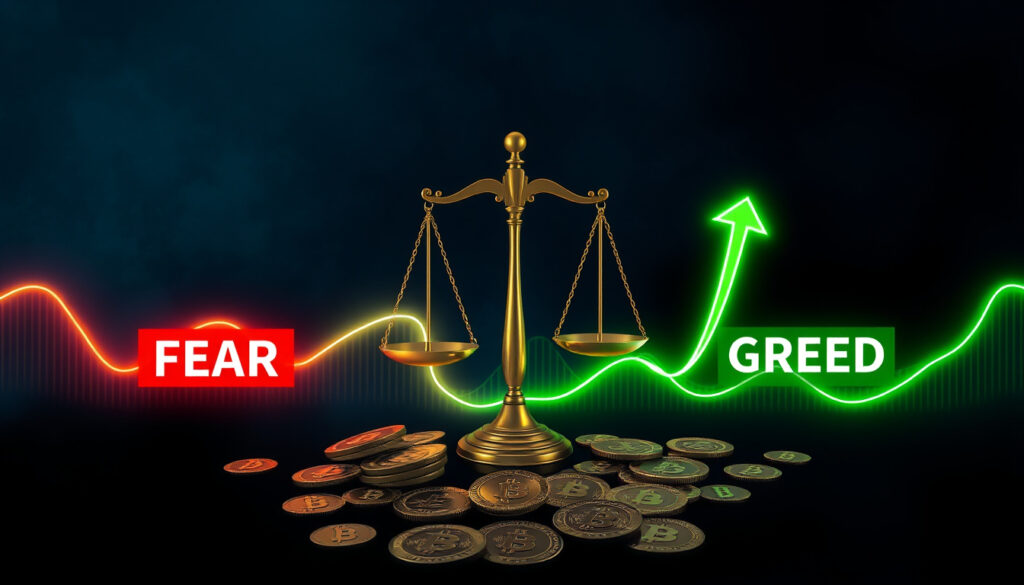
Fear and Greed Index Crypto: What It Is & How to Use It
Few metrics in crypto stir as much debate as the Fear and Greed Index, currently at 23 — deep in “Extreme Fear” territory — leaving traders wondering if that signals a buy opportunity or a deeper slide. This guide unpacks how the index is built, how to read it alongside tax rules like the 30-day rule, and what it actually means for cashing out.
Current Fear and Greed Index value: 23 (Extreme Fear) · Index range: 0 (Extreme Fear) to 100 (Extreme Greed) · Primary source: Alternative.me · Number of data factors: 6 · Update frequency: Daily
Quick snapshot
- Ranges 0 (Extreme Fear) to 100 (Extreme Greed) (Alternative.me (crypto data platform))
- Based on 6 market factors (Alternative.me) (Alternative.me (crypto data platform))
- Updated daily on Alternative.me and exchanges (Swyftx Learn (crypto education))
- Below 25 = Extreme Fear (possible buy) (Swyftx Learn) (Koinly (crypto tax platform))
- Above 75 = Extreme Greed (possible sell) (Swyftx Learn) (Koinly (crypto tax platform))
- Contrarian tool, not a crystal ball (Koinly (crypto tax platform))
- Combine with 30-day tax rule for timing sales (Cointree (Australian exchange))
- Align with 3-5-7 rule for entry/exit (CoinLedger (crypto tax software))
- Helps avoid emotional decisions (Binance Square (exchange community))
- Plan sales around index extremes (CoinMarketCap (market data aggregator))
- Consider OTC desks for large amounts (Swyftx Learn) (CoinMarketCap (market data aggregator))
- Consult tax advisor for HMRC compliance (Koinly) (CoinMarketCap (market data aggregator))
The six input factors and the current extreme-fear reading tell a clear story — but how each implementation weighs those factors varies. Here’s the breakdown across the platforms you’re most likely to use.
| Platform | Update Frequency | Input Factors |
|---|---|---|
| Alternative.me (original index) | Daily (Swyftx Learn) | Volatility, momentum/volume, social media, dominance, trends (surveys paused) (Cointree) |
| CoinMarketCap (proprietary index) | Daily | Price momentum (top 10 coins excl. stablecoins), volatility, social media, dominance, trends (CoinMarketCap) |
| Binance Square (exchange index) | Daily | Similar to Alternative.me methodology (Binance Square) |
| CoinLedger (tax-focused tool) | Every 12 hours (CoinLedger) | Volatility, market momentum, social media, Google Trends (CoinLedger) |
Most platforms borrow Alternative.me’s methodology, but update frequencies and factor weights differ. A 12-hour update vs. 24-hour means traders using short timeframes may see stale data.
What is the fear greed index in crypto?
The Crypto Fear and Greed Index is a sentiment measure that maps market emotion onto a 0–100 scale. Lower values indicate fear, higher values indicate greed — think of it as a collective mood ring for Bitcoin and the broader crypto market (Alternative.me).
How is the fear and greed index calculated?
- Volatility (25%): Measures drawdowns and volatility relative to the 30‑day and 90‑day averages (Alternative.me)
- Market momentum/volume (25%): Compares current market volume and momentum against the past 30‑day average (Alternative.me)
- Social media (15%): Analyzes sentiment on X (formerly Twitter) and Reddit for Bitcoin mentions (Swyftx Learn)
- Surveys (15%, currently paused): Used to solicit direct sentiment from the crypto community (Cointree)
- Bitcoin dominance (10%): A high dominance often indicates risk-off sentiment (Alternative.me)
- Google Trends (10%): Searches for Bitcoin-related terms, normalized to a scale (Alternative.me)
Alternative.me says it analyzes emotions and sentiments from different sources and combines them into one number each day (Alternative.me).
Who created the crypto fear and greed index?
- The index was launched in 2018 by Alternative.me, a crypto data platform (Alternative.me).
- It was inspired by the stock-market version created by CNN Money, adapted for Bitcoin volatility (Swyftx Learn).
The implication: the index is not a government or academic tool — it’s a proprietary product from a niche data provider, which matters when you decide how much weight to give it.
What is a good fear and greed index?
A “good” index value depends entirely on your strategy. Contrarian investors see low readings as buying opportunities and high readings as sell signals. Momentum traders, by contrast, might see Extreme Greed as confirmation to stay long (Koinly).
What does extreme fear signal?
- Values 0–24 indicate Extreme Fear — historically associated with market bottoms and low prices (Swyftx Learn).
- It often correlates with high selling pressure, negative news, and panic (Cointree).
- Some investors treat it as a “buy the dip” signal, though no indicator is foolproof.
What does extreme greed signal?
- Values 75–100 indicate Extreme Greed — historically associated with market tops and euphoria (Swyftx Learn).
- It often coincides with high trading volume and media hype (CoinMarketCap).
- Contrarians may take profits or reduce exposure during these periods.
What this means: the index is a sentiment thermometer, not a timing oracle. A reading of 23 today tells you the crowd is scared — but it cannot tell you whether fear will deepen or fade.
What is the current fear greed index?
As of the latest update, the Crypto Fear and Greed Index stands at 23 (Extreme Fear) (Alternative.me). This is well into Extreme Fear territory, historically a zone where long-term buyers have entered.
Where to find the live fear and greed index?
- Alternative.me — original and most cited source
- CoinMarketCap — proprietary index with 5‑factor methodology
- Binance Square — exchange‑integrated version
- CoinLedger — updates every 12 hours (CoinLedger)
- TradingView — community script using Alternative.me data
How often is it updated?
- Alternative.me and most exchange versions update once per day (Swyftx Learn).
- CoinLedger refreshes every 12 hours (CoinLedger).
- No platform offers real‑time intraday updates — at best you get two daily snapshots.
The trade‑off: a daily index is useful for swing trades and portfolio rebalancing, but useless for scalpers or second‑by‑second decisions.
What is the 30 day rule in crypto?
The 30‑day rule — formally known as the “bed and breakfasting” rule — is a UK HMRC regulation that prevents investors from selling a crypto asset, then repurchasing the same asset within 30 days to realize a tax loss while keeping their position (HMRC Capital Gains Manual (UK tax authority)).
How does the 30-day rule affect tax?
- If you sell Bitcoin at a loss and buy the same Bitcoin back within 30 days, HMRC treats the sale as a “matched” transaction — the loss is not allowed for tax relief (HMRC guidance).
- The same rule applies to same‑day trades: all sales and purchases of the same asset on the same day are matched together.
- This prevents “tax loss harvesting” on temporary dips while holding the asset long‑term.
Does the 30-day rule apply to crypto trading?
- Yes. HMRC confirmed that cryptoassets are subject to the same Capital Gains Tax rules as shares, including the 30‑day rule (HMRC Cryptoassets Manual (UK tax authority)).
- The rule applies only to the same asset, not across different cryptocurrencies.
- If you sell Bitcoin and buy Ethereum, the 30‑day rule does not apply — only same‑asset repurchases are caught.
The catch: using the Fear and Greed Index to sell during Extreme Fear could trigger a 30‑day clock if you plan to buy back the same coin. Timing your exit around the index means also timing your re‑entry to avoid the tax trap.
UK investors selling in today’s Extreme Fear (index 23) to cut losses need to wait 31 days before repurchasing the same crypto if they want the loss to count for tax relief. The index can help you pick the sale date, but the calendar decides your tax outcome.
What did Warren Buffett say about fear and greed?
Warren Buffett’s most famous investing adage — “Be fearful when others are greedy, and greedy when others are fearful” — directly inspired the Fear and Greed Index (Berkshire Hathaway 2008 letter (Warren Buffett)).
How does Buffett’s quote apply to crypto?
- Buffett’s principle is contrarian: buy when the crowd is panicking, sell when the crowd is euphoric.
- The crypto Fear and Greed Index operationalizes that principle into a daily number (Alternative.me).
- In crypto, “greed” can fuel bubbles (e.g., index hit 95 in 2021) and “fear” can create buying opportunities (index hit 6 in 2022) (CoinMarketCap historical data).
Is the fear and greed index based on Buffett’s principle?
- Indirectly. The index is not an official Buffett product, but its creators explicitly cite Buffett’s philosophy as the intellectual foundation (Alternative.me).
- It works as a heuristic, not a predictive model — the index measures current emotion, not future direction.
“Be fearful when others are greedy, and greedy when others are fearful.”
— Warren Buffett, Berkshire Hathaway 2008 Annual Letter
“The Crypto Fear & Greed Index is an overview of the current sentiment of the Bitcoin and crypto market at a glance.”
— Alternative.me, official index description
Buffett himself called Bitcoin “rat poison squared” — yet his fear‑and‑greed principle is now used daily by crypto traders. The index is agnostic to the asset class; it just measures emotion.
The pattern: Buffett’s wisdom provides the philosophical foundation, but the index’s daily number gives traders a concrete trigger point — a combination that works only if you respect the asset’s unique risk profile.
What is the 3-5-7 rule in trading?
The 3‑5‑7 rule is a technical risk‑management guideline for setting stop‑loss and take‑profit levels. A typical pattern: 3% stop‑loss, 5% take‑profit, 7% trailing stop (Investopedia (financial education)).
How does the 3-5-7 rule relate to crypto?
- Traders can combine the Fear and Greed Index with the 3‑5‑7 rule: enter during Extreme Fear (potential 3% stop) and exit during Extreme Greed (5% take‑profit) (CoinLedger).
- The index tells you what the market feels; the 3‑5‑7 rule tells you when to act.
- Example: If the index is 23 (Extreme Fear), you might set a buy with a 3% stop loss below entry and a 5% profit target if the index rises toward 50 (Neutral).
Is the 3-5-7 rule a reliable strategy?
- No single rule guarantees profits — it is a risk management guideline, not a prediction system (Investopedia).
- The rule works best in trending markets; during high volatility, stop‑losses may be hit prematurely.
- Combine with the index to avoid trading against strong sentiment — e.g., don’t short during Extreme Greed.
The pattern: the 3‑5‑7 rule gives you a framework; the index gives you context. Alone, each is weak. Together, they form a repeatable system.
How do crypto millionaires cash out?
Large holders — “whales” — rarely dump into a market order. They use over‑the‑counter (OTC) desks, private sales, and exchange liquidity pools to avoid moving the price (CoinDesk (crypto news)).
What should I know before selling crypto?
- Check the Fear and Greed Index: selling during Extreme Fear (like now at 23) means selling at a sentiment bottom, which may not be the price bottom (CoinMarketCap).
- Understand your tax liability: in the UK, HMRC charges Capital Gains Tax on crypto disposals, with an annual allowance of £6,000 (2024/25) (HMRC (UK tax authority)).
- Consider the 30‑day rule: if you sell and plan to buy back within 30 days, the loss may be disallowed.
- For large positions, use an OTC desk to avoid slippage and signaling.
Can you day trade crypto without $25,000?
- Yes. Unlike US stock markets (Pattern Day Trader rule requires $25k for 4+ day trades in 5 days), crypto trading has no such minimum (SEC (US securities regulator)).
- You can day trade crypto with any account size, though smaller accounts face higher proportional fees.
- The Fear and Greed Index can help day traders avoid trading against extreme sentiment — e.g., avoid shorting when the index is above 70.
For UK investors, the choice is clear: use the index to time your exit, but align it with the 30‑day rule and your tax allowance, or risk losing both the loss relief and the profit.
Confirmed facts vs. what’s unclear
Confirmed facts
- The index scale is 0–100 with Extreme Fear and Extreme Greed endpoints (Alternative.me).
- The index is calculated from six weighted factors (Alternative.me).
- Alternative.me is the original and most cited source (Swyftx Learn).
- Index value today is 23 (Alternative.me live index).
What’s unclear
- Whether the index accurately predicts market tops and bottoms in real time (Koinly).
- The exact weight changes Alternative.me may apply over time — methodology is not audited (Cointree).
- How the index performs across different market cycles (e.g., steady bull vs. flash crash) (CoinMarketCap).
- Whether surveys will resume and how their reintroduction would shift the score (Alternative.me).
For UK crypto investors, the implication is straightforward: the Fear and Greed Index is a useful sentiment compass, but it does not absolve you from understanding the 30‑day rule, your tax allowance, and the 3‑5‑7 rule. Use the index to identify windows of opportunity, but let your tax and risk framework dictate the actual clicks. Ignore the 30‑day trap, and your “smart sell” could become a tax nightmare.
The Crypto Fear and Greed Index provides a useful snapshot of whether traders are overly fearful or greedy.
Frequently asked questions
What is the fear and greed index used for in crypto trading?
It measures market sentiment to help traders decide when to buy (during fear) or sell (during greed). It’s a contrarian indicator, not a prediction tool. (Alternative.me)
Is the fear and greed index reliable for timing the market?
No indicator is 100% reliable. The index reflects current sentiment, which can persist longer than expected. Use it alongside other analysis and risk management. (Swyftx Learn)
Can I see the fear and greed index on TradingView?
Yes. TradingView hosts community scripts that pull Alternative.me data and display the index as a gauge or line chart. (TradingView (charting platform))
What is the difference between fear and greed index for Bitcoin vs. crypto?
Most versions, including Alternative.me’s, focus on Bitcoin and the top coins. Some platforms offer separate indices for different assets, but the methodology is similar. (CoinMarketCap)
Does the index update in real time?
No. It updates daily (or every 12 hours on some platforms). It is not a real-time ticker. (CoinLedger)
Should I buy when the index is in extreme fear?
Historically, extreme fear has coincided with price bottoms, but past performance is not guarantee. Contrarian buying in fear can be profitable if you have a long time horizon and strong risk tolerance. (Cointree)
What does extreme greed mean for selling my crypto?
Extreme greed suggests the market is overbought and due for a correction. Many traders take partial profits or set stop-losses during these phases. (Koinly)
More related posts
 Debby Ryan: DUI, Baby, Husband, and Cameron Boyce Tribute
 Gilles Villeneuve: Ferrari Legend, Crash, and Lasting Legacy
 Best Online Learning Platforms – Top Picks for Students and Adults
 Dog Park Near Me: Co t , Lea h Law & Safety Tip in Ireland
 Gabriela Dabrowski: Ranking, Partner, Split & Personal Life
 Senate Vote on Tariffs: 51-47 Vote Blocks Canada Tariffs
 Elle Chapman: Age, Nationality, Movies, and The Madison Role
 Miss Rachel: Biography, Net Worth, Family, Key Questions