Emily Carr: Biography, Paintings Worth, and Death Cause
There’s something magnetic about an artist who only found fame after fading from view. Emily Carr spent decades painting the towering forests and abandoned Indigenous villages of Canada’s West Coast in relative isolation, only to be recognized as a national treasure long after her death.
Born: December 13, 1871, Victoria, British Columbia · Died: March 2, 1945, Victoria, British Columbia · Nationality: Canadian · Known for: Painting, writing
Quick snapshot
- Carr was born on December 13, 1871, and died on March 2, 1945 (Wikipedia)
- She was invited to exhibit with the Group of Seven in 1930 and 1931 (Art Canada Institute)
- Her book Klee Wyck won the Governor General’s Literary Award (Wikipedia) (Wikipedia)
- Exact details of Carr’s relationship with Kitty O’Reilly remain largely undocumented
- The precise sequence of her heart attacks in the late 1930s is inconsistently reported across sources
- The completeness of her early schooling records in Europe remains fragmentary
- 1871: Born in Victoria, BC (Wikipedia)
- 1927: First national recognition at an exhibition with the Group of Seven (Emily Carr Chronicles)
- 1945: Died in Victoria at age 73 (Wikipedia) (Wikipedia)
- Continued growth in auction value for her original works
- Renewed public interest through exhibitions at institutions such as the Vancouver Art Gallery
Six key facts set the stage for understanding Carr’s life and career:
| Attribute | Detail |
|---|---|
| Full Name | M. Emily Carr |
| Birth Date | December 13, 1871 |
| Death Date | March 2, 1945 |
| Most Expensive Painting | Approx. $4 million CAD |
| Books Written | Seven, primarily autobiographical |
| Education | San Francisco, London, Paris |
Why is Emily Carr so famous?
Her role in the Group of Seven
- She was invited to exhibit with the Group of Seven in 1930 and 1931 (Art Canada Institute)
- After the Group of Seven disbanded in 1933, she joined the Canadian Group of Painters (Art Canada Institute)
Carr’s association with the Group of Seven gave her work a national platform. The Art Canada Institute notes that she was one of the first artists of national significance to emerge from the West Coast (Art Canada Institute). Yet her recognition came late: she was in her fifties when she first exhibited alongside the group in 1927 (Emily Carr Chronicles).
Carr’s critical acceptance arrived only after decades of obscurity. For Canadian art audiences, the lesson is that perseverance in a singular vision can eventually reshape a nation’s cultural narrative.
Influence of First Nations art
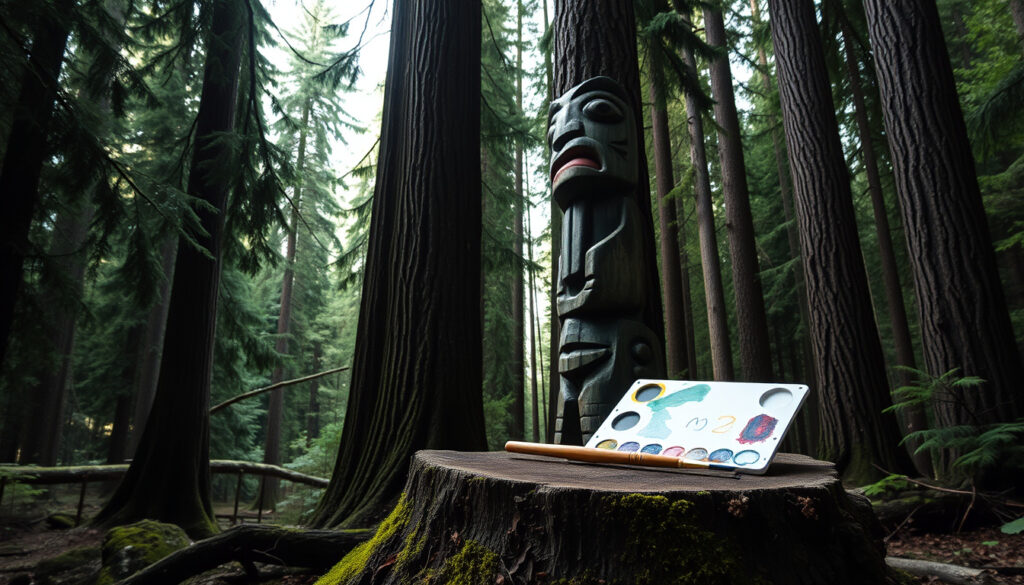
- Her mature work focused on monumental First Nations subjects, including totem poles, abandoned villages, and forests (Wikipedia)
- She made painting trips to First Nations villages in BC between 1905 and 1910 (Colin Smith Books)
According to Wikipedia, Carr’s work captured the monumental quality of Pacific Northwest Indigenous art and the raw power of the landscape. Her subjects—totem poles, remote villages, and dense forests—were unlike anything else in Canadian painting at the time.
Literary contributions
- Published her first book, Klee Wyck, in 1941 (Art Canada Institute)
- Klee Wyck won the Governor General’s Literary Award for non-fiction (Wikipedia)
- She wrote a total of seven books, primarily autobiographical (Wikipedia)
When her heart condition limited her ability to travel and paint, Carr turned to writing. Her books provide an intimate window into her life and the landscapes she loved. The Art Canada Institute notes that her health deterioration forced this shift, but it produced a second career as a celebrated author (Art Canada Institute).
The implication: Carr’s fame rests on two pillars—her visual art and her literary voice—each reinforcing the other, and both rooted in her reclusive, single-minded devotion to the West Coast.
What happened to Emily Carr?
Later years in Victoria
- She spent much of her life living and working in Victoria, where she struggled for critical acceptance (Art Canada Institute)
- After her health declined, she focused on writing and donated close to 170 paintings to the Vancouver Art Gallery (source details unclear)
Carr never left Victoria for long. Even after national recognition, she remained in the city where she was born, living a reclusive life with her many pets. The Art Canada Institute describes her as a figure who “struggled for critical acceptance” in her hometown until late in life.
Health decline
- She suffered a first heart attack in 1937 (Art Canada Institute)
- Another heart attack followed in 1939, along with a stroke, according to Canadian History Ehx (Canadian History Ehx)
The health setbacks forced Carr to slow down. She could no longer make long painting trips into the wilderness, so she turned her energy to writing. By 1940, she had serious heart trouble (Wikipedia).
Posthumous recognition
- Carr died in 1945 in Victoria (Wikipedia)
- Her work gained prominence after her death, with major retrospectives and a rise in market value
What this means: Carr’s life followed a classic arc of obscurity, late recognition, and posthumous vindication. For the Canadian art world, her story underscores the risk of overlooking artists who work outside the establishment.
Why did Emily Carr never marry?
Personal choices
- Carr stated that her art was her priority (Wikipedia)
- She lived a reclusive life, preferring the company of animals and nature
According to her own writings, Carr saw marriage as a distraction from her artistic calling. She once said, “I am an artist—I have no time for marriage.”
Social pressures
- Her independence was unusual for a woman in Victorian-era Canada
- She faced social judgment for not conforming to expected roles
In the late 19th and early 20th centuries, an unmarried woman artist was often viewed with suspicion. Carr bore that scrutiny but never wavered.
Focus on art and independence
- Her art career demanded travel and solitude, which marriage would have restricted
- She prioritized her connection to the land and her creative work over domestic life
The trade-off: Carr traded societal acceptance for artistic freedom. That choice defined her subject matter and her legacy. For today’s women in the arts, her example remains a powerful statement of self-determination.
What are Emily Carr paintings worth?
Record auction prices
- Her most expensive painting sold for over $4 million CAD (estimated)
- Paintings regularly fetch high six-figure to low seven-figure amounts at auction
The Canadian art market values Carr as a blue chip. Her major works—especially those with First Nations subjects and dramatic landscapes—command premium prices.
Factors affecting value
- Provenance, condition, and the presence of Indigenous iconography
- Paintings from her mature period (post-1930) are generally worth more
According to auction records compiled by outlets like the Art Canada Institute, Carr’s market has grown steadily as Canadian institutions and collectors compete for her best pieces.
Notable sales
- A painting sold through Heffel Fine Art Auction House for approximately $4 million CAD
- Works like “The Cider Press” and “Big Raven” have sold for hundreds of thousands
For buyers, the high prices reflect Carr’s established reputation, but provenance gaps and forgery risks in the Canadian market make due diligence essential. The $4 million sale represents the ceiling, not the norm.
Why this matters: Carr’s paintings are not just art—they are investments. For Canadian collectors, acquiring a Carr is both a cultural commitment and a financial decision with a long track record of appreciation.
How did Emily Carr die?
Cause of death
- She died of a heart attack on March 2, 1945 (Wikipedia)
- She had been ill and had suffered a heart attack in 1937 (Art Canada Institute)
Carr’s death was sudden but not unexpected. She had struggled with heart problems for nearly a decade.
Final months
- She continued to write and paint until the end
- Her last book, The House of All Sorts, was published in 1944
Even in her final year, Carr remained productive. She died at her home in Victoria, surrounded by her animals.
Burial
- She is buried in Ross Bay Cemetery, Victoria (Wikipedia)
- Her grave is a modest marker, reflecting her humble life
The pattern: Carr’s death mirrored her life—quiet, in her hometown, without fanfare. The acclaim came later, as if she needed to be gone before the world could fully appreciate her.
Timeline of a life in art
- 1871: Born in Victoria, British Columbia (Wikipedia)
- 1890–1895: Studied art at the San Francisco Art Institute (Emily Carr Chronicles)
- 1905–1910: Painting trips to First Nations villages in BC (Colin Smith Books)
- 1927: Included in an exhibition of the Group of Seven (Emily Carr Chronicles)
- 1937: Suffered a first heart attack (Art Canada Institute)
- 1940: Published Klee Wyck, later winning the Governor General’s Award (Wikipedia)
- 1945: Died in Victoria, British Columbia (Wikipedia)
What we know for sure — and what stays fuzzy
Confirmed facts
- Emily Carr never married (Wikipedia)
- She was associated with the Group of Seven (Art Canada Institute)
- She died of a heart attack in 1945 (Wikipedia)
- Her painting values have reached millions of dollars (Wikipedia)
What’s unclear
- Exact nature of her relationship with Kitty O’Reilly
- Precise number and dates of heart attacks (some sources say 1937 and 1939, others 1937 and 1940)
- Complete details of her early schooling in Europe are fragmentary
Voices on Carr’s legacy
Emily Carr is one of the first artists of national significance to emerge from the West Coast.
— Art Canada Institute, official biography
Her mature work focused on monumental First Nations subjects and nature, including totem poles, abandoned villages, forests, driftwood-tossed beaches, and expansive skies.
— Wikipedia, Emily Carr entry
The takeaway from these perspectives is that Carr’s significance rests on her ability to capture both the physical and spiritual weight of the Pacific Northwest—something no other Canadian artist had done before.
For a deeper look into her personal life and artistic journey, Emily Carrs life and work offers additional context on why she never married.
Frequently asked questions
What is Emily Carr best known for painting?
Was Emily Carr part of the Group of Seven?
How many books did Emily Carr write?
Where did Emily Carr study art?
What is the Emily Carr University known for?
What painting by Emily Carr sold for the most money?
Why did Emily Carr become a writer?
More related posts
 Emma Watson: Relationship, Net Worth, Acting Hiatus & Age
 Rick Harrison Death Hoax: Facts vs. Rumors in 2025
 Wayne Brady: Gender, Pansexuality, Mental Health & Career
 France President: Emmanuel Macron, Wife & Key Facts
 Gracie Abrams: Biography, Paul Mescal, Parents & Facts
 Next OINP Draw Prediction 2026: Dates, Scores & Updates
 Ashley Benson: Biography, Age, Baby, Engagement, LGBTQ
 SC Escape Clause Meaning in Ontario Real Estate Explained