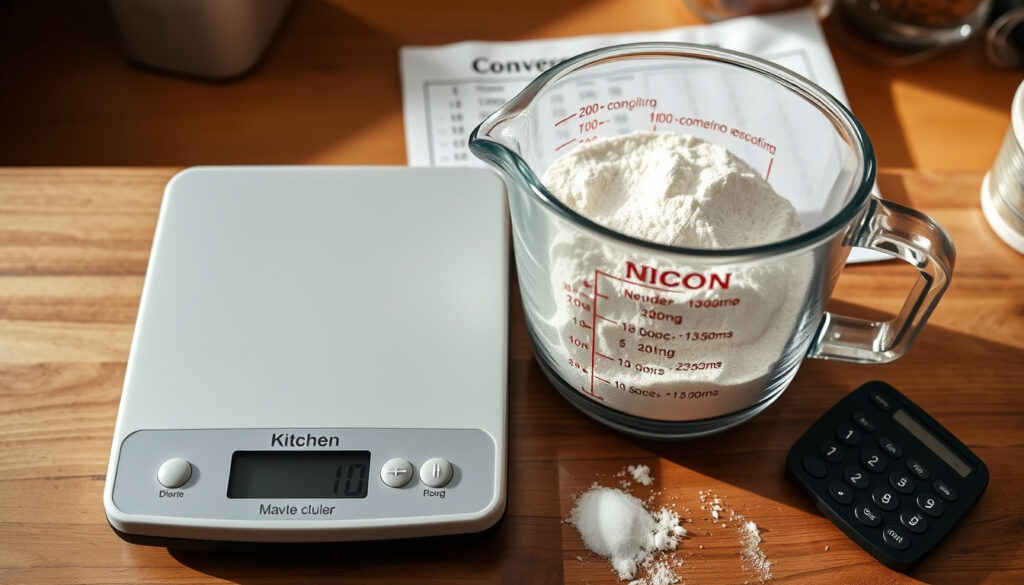
Grams to Cups Conversion: Accurate Charts & Calculator
Anyone who has tried baking from a recipe that lists flour in cups and sugar in grams has felt the confusion. The truth is that 1 cup of water weighs much more than 1 cup of flour—and that difference can make or break a cake.
1 cup of water: 240 grams · 1 cup of all-purpose flour: 125 grams · 1 cup of granulated sugar: 200 grams · 1 cup of butter: 227 grams · 100 grams of flour: 0.8 cups (approx.) · 200 grams of sugar: 1 cup
Quick snapshot
- 1 cup = 125 g (The Calculator Site)
- Density varies with sifting (The Calculator Site)
- Use spoon & level method (The Calculator Site)
- 1 cup = 200 g (Doves Farm)
- Density ≈ 0.85 g/mL (Doves Farm)
- Similar for brown sugar packed (Doves Farm)
- 1 cup = 227 g (USDA ARS)
- 2 sticks = 1 cup (USDA ARS)
- Density ≈ 0.96 g/mL (USDA ARS)
Six common ingredient weights, one pattern: the same cup volume holds radically different masses depending on what you scoop.
| Ingredient | 1 Cup Weight (grams) | Density (g/mL) | Notes |
|---|---|---|---|
| Water | 240 | 1.00 | Room temperature, US legal cup |
| All-purpose flour | 125 | 0.52 | Spooned and leveled |
| Granulated sugar | 200 | 0.85 | Unsifted |
| Butter | 227 | 0.96 | Solid, no air pockets |
| Brown sugar (packed) | 220 | 0.92 | Firmly packed into cup |
| Cake flour | 120 | 0.50 | Light, finely milled |
The implication: whenever a recipe says “1 cup of flour,” the actual weight can swing 20–30 g depending on how you fill the cup — that’s enough to change a cake crumb.
How much is 1 cup in grams?
A US legal cup, the standard for home baking in the United States, holds exactly 240 milliliters of volume USDA ARS (U.S. Department of Agriculture’s Agricultural Research Service). But grams measure mass, not volume, so what 1 cup weighs depends entirely on the ingredient. Water, with a density of 1 g/mL, gives 240 grams. Flour, which traps air, comes in at about 125 g. Sugar is around 200 g. Butter, with some water and fat, lands at 227 g.
Standard US cup volume (240 ml)
- The USDA explicitly defines 1 cup = 16 tablespoons = 8 fluid ounces = 240 ml. USDA ARS
- Some countries (Australia, Canada, South Africa) use a 250 ml metric cup. Doves Farm (British organic flour miller) That 10 ml difference adds about 4% to gram weights.
Weight varies by ingredient density
- Ingredient density is mass divided by volume. A dense ingredient like honey (1.4 g/mL) pushes 336 g per cup; a light one like powdered sugar (0.56 g/mL) weighs only 134 g. Instacart (online grocery marketplace)
Quick reference: water, flour, sugar, butter
- Water: 240 g per US cup
- All-purpose flour: 125 g per US cup The Calculator Site (baking conversion reference)
- Granulated sugar: 200 g per US cup Doves Farm
- Butter: 227 g per US cup USDA ARS
Home bakers who treat “1 cup” as a universal 240 g end up with dry cakes from too much flour and greasy batters from too little butter. The density gap between flour and water is nearly half — that’s a 115-gram swing per cup.
The pattern: volume alone is useless without density. Every cup measurement should come with a mental asterisk: “this weight is true only for this ingredient at this density.”
What is 100g in cups?
“The most accurate way to measure flour is by weight, not volume.”
— The Calculator Site (baking conversion expert)
When a recipe calls for 100 g of an ingredient, you need its density to flip it into cups. Below are four common ingredients with their cup equivalents for 100 g.
100g flour to cups
- 100 g all-purpose flour = 0.8 cups The Calculator Site. That’s about ¾ cup plus 1 tablespoon.
100g sugar to cups
- 100 g granulated sugar = 0.5 cups (exactly ½ cup) The Calculator Site.
100g butter to cups
- 100 g butter = 0.44 cups (a little less than ½ cup) The Calculator Site.
100g water to cups
- 100 g water = 0.42 cups (a bit under ½ cup) – calculated from density 1 g/mL.
For 100 g of flour, using a cup measure without a scale can land you anywhere from 120 g to 135 g depending on packing. That 20% error turns a tender scone into a hockey puck.
The catch: converting 100 g to cups is simple arithmetic once you know density, but without density you’re guessing.
How to convert grams to cups?
The conversion formula is straightforward: cups = grams ÷ (ingredient density × cup volume). But because most home kitchens lack density data, you need either a calculator or a reference table.
Using a grams-to-cups calculator
- Online tools like The Calculator Site let you select an ingredient and enter grams to get cups instantly. The Calculator Site (baking conversion reference)
- Many recipe sites embed calculators; Instacart’s guide also provides a formula. Instacart (online grocery marketplace)
Manual formula: cups = grams / (density × cup volume)
- Find ingredient density (g/mL) from a reliable source.
- Multiply density by 240 (US cup volume) to get grams per cup.
- Divide your grams by that number.
Example: 200 g of all-purpose flour (density 0.52 g/mL) → 0.52 × 240 = 124.8 g per cup → 200 ÷ 124.8 ≈ 1.6 cups. The Calculator Site
Importance of ingredient density tables
- Without density, the formula is useless. Published tables from USDA, Doves Farm, and The Calculator Site give density figures for dozens of ingredients.
- Even small density variations (e.g., sifted vs. unsifted flour) shift the result noticeably.
A “grams to cups” chart that lists only water equivalents will mislead you for every other ingredient. Always use ingredient-specific density data.
The upshot: manual conversion is a two-step process — find density, then compute. A calculator is faster and less error-prone.
Is 1 cup the same as 250g?
Only if the ingredient has a density of about 1.04 g/mL, which is close to water but not to flour or sugar. The common confusion stems from metric-system countries where 1 cup is defined as 250 ml, making 1 cup of water equal to 250 g. But in US recipes, 1 cup = 240 ml, and for non-water ingredients the weight is much lower.
Water and liquids: 1 cup ≈ 240-250g (US vs metric)
- US cup: 240 g water. USDA ARS
- Metric cup: 250 g water. Doves Farm
Flour is much lighter than water
- 1 cup flour ≈ 125 g, not 250 g. Using a 250 g assumption would double the flour in a recipe. The Calculator Site
Sugar is close but not exact
- 1 cup sugar ≈ 200 g. That’s 50 g less than 250, a 20% discrepancy that affects sweetness and texture. Doves Farm
The pattern: the 1 cup = 250 g shortcut works only for water. For baking, it’s dangerously wrong.
Is 200 grams in 1 cup?
Only for granulated sugar and a few other ingredients with similar density. For most pantry staples, 200 g is more or less than one cup.
200g of sugar = 1 cup
- Granulated sugar: 200 g = exactly 1 US cup. The Calculator Site
200g of flour = 1.6 cups
- All-purpose flour: 200 g = 1.6 cups. The Calculator Site
200g of butter = 0.88 cups
- Butter: 200 g = 0.88 cups (just under 7/8 cup). USDA ARS
The implication: never assume a round number like 200 g equals one cup unless you know the ingredient.
Is 1 cup of flour 100g?
No. Standard all-purpose flour weighs 125 g per US cup, not 100 g. The misconception arises because some recipes use a “cup” that is loosely measured or because scooping flour directly from the bag can pack it denser.
Standard all-purpose flour: 1 cup = 125g
- The Calculator Site and Doves Farm both list 1 cup AP flour at 125 g. The Calculator Site Doves Farm
Variation by flour type
- Cake flour: 1 cup ≈ 120 g. Doves Farm
- Whole wheat flour: 1 cup ≈ 130 g. Doves Farm
Scooping vs spooning method affects weight
- Scooping a cup directly from the flour bin can pack the flour and increase weight to 140–150 g. Spooning flour into the cup and leveling with a knife yields the standard 125 g. Instacart
“Cup measurements are approximate because of brand variation, measurement method, and scale calibration.”
— Eat, Little Bird (food blog)
The catch: if a recipe says “1 cup flour” without specifying the method, you could be off by 20% or more.
Steps to convert grams to cups manually
Follow this process when you don’t have an online calculator handy.
- Identify the ingredient and locate its density (g/mL) from a trusted source like USDA or The Calculator Site.
- Calculate grams per cup: density × 240 (US cup volume) or × 250 (metric cup).
- Divide your target grams by the grams-per-cup figure.
- Round to the nearest 0.05 cup for practical measuring (e.g., 0.8 cup = ¾ cup + 1 tablespoon).
For most home bakers, a printed conversion chart covering 6–8 common ingredients is more practical than doing the math each time.
Clarity: confirmed facts and what remains unclear
Confirmed facts
- 1 US cup = 240 ml volume. USDA ARS
- 1 cup water = 240 g at room temperature. USDA ARS
- Flour density varies with compaction — standard weight is 125 g per cup. The Calculator Site
What’s unclear
- Exact weight for packed brown sugar can differ by brand because of moisture content.
- Weight of 1 cup of nuts depends on chop size — whole almonds weigh differently than slivered.
- Weight of 1 cup of sifted flour can differ from unsifted due to aeration.
These uncertainties underscore the need for ingredient‑specific density data when converting.
Summary
Converting grams to cups is not a one-number game. Density dictates the translation, and ignoring it leads to failed bakes and wasted ingredients. For home bakers in the US, the choice is clear: invest in a $15 digital kitchen scale and use weight measurements for flour and sugar, or keep a density-aware conversion chart taped inside your cupboard door.
For a comprehensive reference, our grams to cups conversion charts provide ingredient-specific weights for flour, sugar, and butter.
Frequently asked questions
What is the difference between US and metric cups?
The US legal cup is 240 ml; the metric cup used in Australia, Canada, and South Africa is 250 ml. That 10 ml difference adds about 4% to gram weights.
Why do grams to cups conversions vary by ingredient?
Because grams measure mass and cups measure volume. Ingredients with different densities (e.g., 0.52 g/mL for flour vs. 1.00 g/mL for water) pack different masses into the same cup volume.
How do I measure flour correctly for weight?
Spoon flour into the measuring cup and level it with a knife (don’t scoop). This gives the standard 125 g per cup. For most accurate results, use a scale.
Can I use a grams to cups converter for all recipes?
Yes, but only if the converter accounts for ingredient density. A one-size-fits-all converter based on water will give wrong numbers for flour, sugar, butter, etc.
How many cups is 500 grams of flour?
500 g of all-purpose flour = 4 cups (500 ÷ 125). For other flours, adjust using their specific cup weight.
What is the easiest way to convert grams to cups without a scale?
Use a reliable online calculator that lets you select the ingredient and inputs grams. The Calculator Site and Instacart offer such tools.
Are liquid and dry cup measurements the same?
Yes, volume-wise a liquid measuring cup and a dry measuring cup hold the same amount. But liquid cups have a spout for pouring, while dry cups are designed for leveling.
These answers cover the most common conversion pitfalls home bakers encounter.
More related posts
 Canada Summer Games 2025 St. John’s: Schedule, Sports & More
 Charlotte Tilbury Pillow Talk – Shades and Dupes Guide
 Emma Watson: Relationship, Net Worth, Acting Hiatus & Age
 Phillip Danault: Biography, Contract, Stats & Trade History
 Best Online Learning Platforms – Top Picks for Students and Adults
 MLB The Show 24 Review: Gameplay, Story Mode & More
 Ariana Madix: Net Worth, Legal Battle & Career Pivot
 Nick Kroll: Biography, Net Worth, and Family