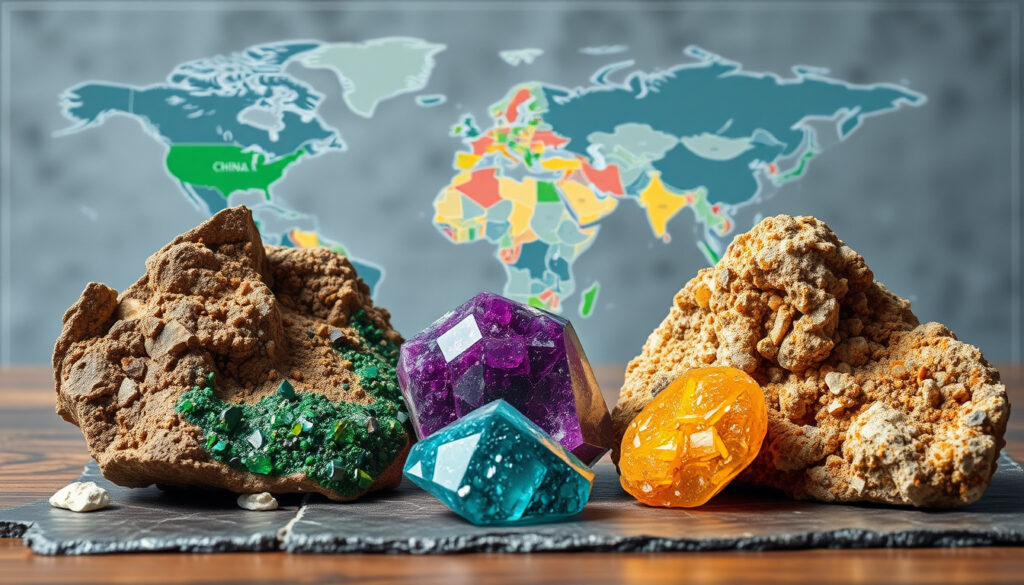
Rare-Earth Elements: Countries, Minerals, and Critical Role
You have probably held a smartphone or driven an electric vehicle without thinking about the 17 metallic elements inside that make them possible, as rare-earth elements (REEs) are the quiet backbone of modern technology—from permanent magnets in wind turbines to lasers in defense systems. This guide breaks down which countries control these critical minerals, their unique properties, and the geopolitical stakes behind the supply chain.
Number of rare-earth elements: 17 ·
Global reserves (2022): 120 million metric tons (USGS) ·
China’s share of global production: ~60% ·
Only operating US mine: Mountain Pass, California
Quick snapshot
- 17 metallic elements classified as rare earths (U.S. DOE NETL)
- China is the largest producer and refiner (Our World in Data)
- Essential for permanent magnets in EVs and wind turbines (World Resources Institute)
- Whether non-Chinese producers can scale processing fast enough (Belfer Center)
- Economic viability of new mining projects (e.g. Greenland, Australia) (Belfer Center)
- Impact of recycling on import dependency (World Resources Institute) (Belfer Center)
- 1787: First REE discovered (yttrium)
- 1960s–1980s: US was leading producer (Mountain Pass)
- 2010: China restricts exports, prices spike
- 2020s: EU, US, Japan invest in domestic mining
- US and EU accelerate domestic processing projects (U.S. DOE NETL)
- Recycling and substitute materials research grows
- Geopolitical tensions may drive further export controls (Belfer Center)
The table below summarizes key facts about rare-earth elements, including their number, name origin, primary use, and production data.
| Number of elements | 17 |
| Name origin | “Rare” due to difficulty in extraction, not scarcity |
| Primary use | Permanent magnets in clean energy and electronics |
| Top producer (2023) | China (~210,000 metric tons) |
| US production (2022) | 43,000 metric tons from Mountain Pass |
Which country has the most rare earth elements?
China holds the largest reserves and dominates both mining and refining. According to Our World in Data, China accounted for more than two-thirds of global rare earth production in 2024. The United States, Myanmar, Thailand, and Australia were also significant producers.
Where do 98% of rare earth minerals come from?
The figure of 98% often refers to China’s near-total dominance in refining, not mining. Belfer Center reports that China refines about 90% of rare earth elements, based on International Energy Agency data. For ore extraction, China’s share was about 69% in 2023. The rest comes primarily from the US, Myanmar, and Australia.
The implication: raw reserves are spread across many countries, but the processing bottleneck is overwhelmingly Chinese.
China’s refining dominance means even countries with large reserves cannot bypass Beijing’s processing infrastructure without years of investment and new technology.
The implication: control of processing is more critical than raw reserves in the rare-earth supply chain.
What are the top 5 rare earth minerals?
The most economically important rare earth minerals are bastnäsite, monazite, xenotime, lateritic ion-adsorption clays, and loparite. Bastnäsite and monazite are the primary sources of light rare earths, while xenotime and ion-adsorption clays are rich in heavy rare earths. These minerals contain varying proportions of the 17 REEs, and their distribution affects extraction economics.
For example, bastnäsite from Mountain Pass is rich in cerium, lanthanum, and neodymium—key for magnets. Monazite often contains thorium as a byproduct, raising environmental concerns.
What is special about rare earth elements?
Rare earths are chemically similar but exhibit unique magnetic, luminescent, and catalytic properties. They are essential for permanent magnets used in electric vehicles and wind turbines, for phosphors in LED screens, and for catalysts in petroleum refining.
Despite the name, they are relatively abundant in the Earth’s crust—cerium is more common than copper. Their “rarity” stems from the difficulty of separating them into pure metals, a complex process dominated by China.
Without rare earths, modern electronics, defense systems, and the clean energy transition would stall. A smartphone contains up to 8 different REEs, and a single electric vehicle uses about 2–3 kg of neodymium magnets.
The catch: despite their abundance, the difficulty of separation makes them strategically scarce.
What rare earth elements are in the EU?
The European Union has identified 15 critical rare earth elements, including neodymium, praseodymium, dysprosium, and terbium. According to World Resources Institute, the EU relies heavily on imports, particularly from China. Efforts to develop domestic mining (e.g., in Sweden, Finland) and recycling programs are underway, but processing capacity remains minimal.
The trade-off: the EU’s green deal ambitions for wind turbines and EVs depend on a secure supply, yet no significant domestic refining exists.
Who owns the only rare earth mine in the US?
Mountain Pass in California is the only operating rare earth mine in the United States. It is owned by MP Materials, which acquired the site in 2017. The mine produces bastnäsite concentrate, which is then shipped to China for processing—a stark illustration of the refining gap.
In 2022, Mountain Pass produced about 43,000 metric tons of rare earth oxides, providing a small but critical domestic supply.
The pattern: even the US mine must send its ore to China for final separation, highlighting the depth of the processing dependency.
What this means: even the US mine is not independent; processing remains the bottleneck.
Country comparison: reserves, production, and refining
Five countries control the vast majority of mined output, but only one dominates the next step. This table shows the imbalance.
| Country | Reserves (million metric tons) | Production (2023, metric tons) | Refining control |
|---|---|---|---|
| China | 44 | ~210,000 | ~90% of global refining (Belfer Center) |
| Vietnam | 22 | ~2,000 | Minimal |
| Brazil | 21 | ~1,500 | Minimal |
| Russia | 21 | ~2,600 | Moderate (domestic use) |
| United States | 2.3 | 43,000 | Negligible (ore exported) |
| Myanmar | N/A | ~38,000 | Ore exported to China |
| Australia | 4.2 | ~10,000 | Growing (Lynas processing plant) |
| Sources: Our World in Data, USGS 2023, Belfer Center | |||
The pattern: despite significant reserves in many countries, refining capability is overwhelmingly concentrated in China.
What we know and what remains uncertain
Confirmed facts
- Seventeen elements are classified as rare earths.
- China is the largest producer and refiner.
- Rare earths are essential for permanent magnets in EVs and wind turbines.
- Mountain Pass is the only US mine.
- Global reserves total about 120 million metric tons (USGS).
What’s unclear
- Whether non-Chinese producers can scale processing to reduce dependence.
- Economic viability of new mining projects (e.g., in Greenland, Australia).
- Impact of recycling technologies on import needs.
- How fast the EU can build domestic supply chains.
The takeaway: while the confirmed facts are clear, the uncertainties highlight the need for investment in processing and recycling.
“Rare earth elements are critical materials for clean energy technologies, including electric vehicles and wind turbines.”
— U.S. Department of Energy NETL
“The United States is heavily reliant on imports for many mineral commodities, including rare earths.”
— USGS National Minerals Information Center
The data is clear: rare earths are not geologically rare, but they are strategically scarce. The concentration of refining in China creates a single point of failure for global supply chains. For policymakers in the US and EU, the choice is stark: invest heavily in domestic processing and recycling, or remain vulnerable to supply disruptions from Beijing.
För den som vill följa marknadens utveckling kan Lynas Rare Earths aktiekurs ge en indikation på efterfrågan utanför Kina.
Frequently asked questions
How many rare earth elements are there?
There are 17 rare earth elements: the 15 lanthanides plus scandium and yttrium.
Why are they called rare earth?
The name refers to the difficulty of extraction, not actual scarcity. Many are relatively abundant in the Earth’s crust.
What are light rare earth elements vs heavy rare earth elements?
Light REEs (e.g., lanthanum, cerium, neodymium) are more abundant and mined from bastnäsite. Heavy REEs (e.g., dysprosium, terbium) are less common and sourced mainly from ion-adsorption clays in China.
Where are rare earth elements mined?
China, the United States (Mountain Pass), Myanmar, Australia, and Thailand are the top producers.
What is the environmental impact of rare earth mining?
Mining and processing generate radioactive waste (thorium, uranium) and toxic chemicals. Unregulated operations in Myanmar and China have caused water and soil contamination.
Can rare earth elements be recycled?
Yes, but recycling rates remain below 1%. Research is underway to recover REEs from magnets, batteries, and electronics.
What are the main uses of rare earth elements in everyday life?
Smartphones, electric vehicles, wind turbines, MRIs, lasers, and weapon guidance systems all rely on REEs.
Related reading: Canadian Tariffs on US Goods · The True Size Of Countries
More related posts
 Jay Cutler: NFL Quarterback and 4-Time Mr. Olympia
 Steal a Brainrot Roblox – Guide, Tips and Strategies
 Levi’s Jeans 501 vs 505: Which Fit Is Best for Your Body
 Kate McKinnon: SNL Exit, Diagnosis, and Life After
 Punch Monkey: The Baby Macaque Who Overcame Bullying
 Ashley Benson: Biography, Age, Baby, Engagement, LGBTQ
 Demi Engemann: Age, Husband, Children, and IVF Journey
 ASUS ROG Ally X: Specs, vs Steam Deck & Worth It 2025